
Doveweed
Murdannia nudiflora
| Type | Broadleaf |
|---|---|
| Life cycle | Summer annual |
| Family | Spiderwort family (Commelinaceae) |
| Origin | Introduced from elsewhere |
| Most common in | Southeast |
About
Doveweed is a creeping, grass-like summer weed from southern Asia that loves soggy lawns and beds in the Southeast. It hides easily in St. Augustinegrass and centipedegrass, and broken stem pieces root again, so it can take two or three years to beat.
Also called nakedstem dewflower, naked stem dewflower
How to identify it
Look for
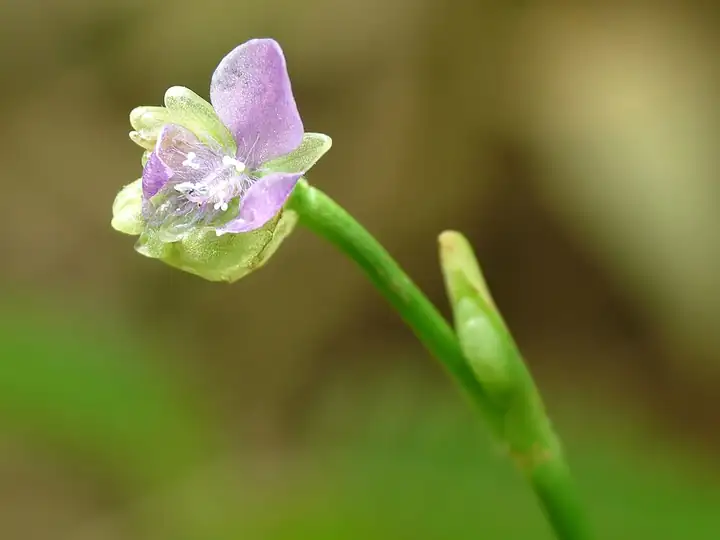
Leaves are thick, shiny and narrow, 2 to 5 inches long, with parallel veins like a grass blade. The smooth, often purplish stems creep along the ground and root at the joints. In summer and fall it opens small flowers with three lavender to purple petals.
Look-alikes
It looks like a grass, but its thick, shiny leaves and three-petaled flowers give it away. Related dayflowers and dewflowers look similar but are usually bigger, with wider leaves.
Where it grows
Wet spots in lawns and landscape beds, poorly drained soil, ditches and overwatered areas.
When
Seeds sprout in late spring once soil reaches about 65 to 70 F; it flowers from midsummer into fall and dies with frost.
How it spreads
Each plant can make 500 to 2,000 seeds that need light to sprout, and stem pieces left behind can reroot.
Most common in
| Northeast | Not found here |
|---|---|
| Southeast | Very common here |
| South Central | Common here |
| Midwest | Not found here |
| Great Plains | Not found here |
| Mountain West | Not found here |
| Southwest | Not found here |
| Pacific Northwest | Not found here |
| California | Not found here |
| Alaska | Not found here |
| Hawaii | Occasional here |
What to do, gentlest first
Start at the top. Weed killers are a last step; always read and follow the label.
Fix wet spots and water less often Prevent
Water deeply but infrequently so the surface dries, core aerate and correct drainage. Mow at the right height for your grass so stems aren't chopped and spread.
Pull small patches carefully By hand
Hand-weed young plants in beds and bag every piece.
Stem and root pieces left behind resprout, so pulling alone rarely works in lawns.
Mulch beds Barrier
A 1 to 3 inch mulch layer cuts down germination, since the seeds need light to sprout.
Fatty-acid burndown on small plants Organic spray
UF/IFAS lists pelargonic acid (a fatty-acid contact spray) for small plants in beds.
It only burns the tops it touches, so expect to repeat. Keep it off plants you want.
Pre-emergent in spring, then spot treatments Conventional spray
Clemson lists indaziflam as a spring pre-emergent in lawns, and atrazine (centipedegrass and St. Augustinegrass only) or 2,4-D, dicamba and mecoprop (MCPP) products after green-up. For big solid patches, glyphosate then new sod.
Read and follow the label. Many lawn weed killers also kill garden plants, so keep spray and drift off beds and vegetables. Don't use atrazine near water, on drought-stressed lawns, or above 90 F.
Uses, wildlife and pets
Pets
Not listed by the ASPCA.
Sources
Photo: Photo: Jeevan Jose, Kerala, India / Wikimedia Commons, CC BY-SA 4.0 (CC BY-SA 4.0). Photo resized for the web.

Planting dates and advice are general guidance; check with your local Cooperative Extension office for your area.