
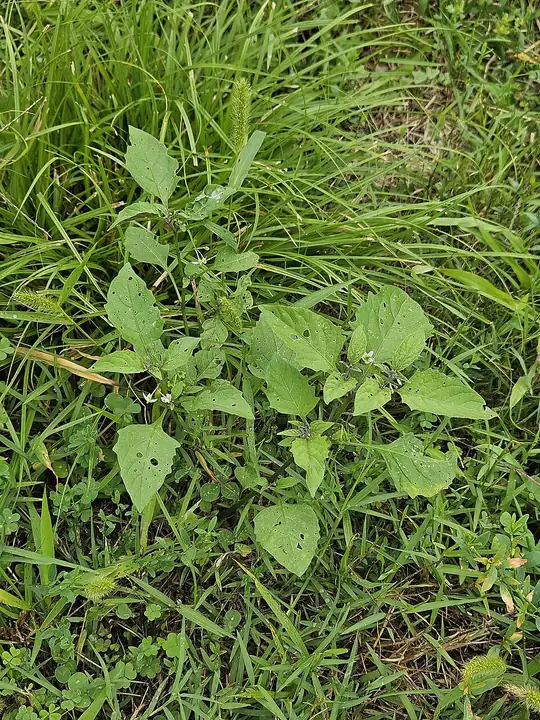
Eastern black nightshade
Solanum ptycanthum
| Type | Broadleaf |
|---|---|
| Life cycle | Summer annual |
| Family | Nightshade family (Solanaceae) |
| Origin | Native to the US |
| Most common in | Northeast, Southeast, Midwest |
About
The most common black nightshade east of the Rockies, a bushy native annual with small white star flowers and clusters of shiny black berries. Its leaves and green berries are poisonous, and it harbors pests and diseases of tomatoes, potatoes and peppers.
Also called black nightshade, West Indian nightshade
How to identify it
Look for
Plants grow 1-3 feet with nearly hairless stems and oval to triangular leaves with wavy or shallowly toothed edges; young leaves are often purple underneath. Drooping clusters of 4-7 small white to pale purple star flowers with yellow centers become green berries that ripen shiny purple-black, about 3/8 inch wide.
Look-alikes
Hairy nightshade has sticky, hairy stems and greenish berries partly covered by the sepals, and horsenettle and buffalobur are prickly. Treat every wild nightshade berry as unsafe to eat.
Where it grows
Vegetable gardens, crop fields, pastures, woodland edges and roadsides, in fertile, moist soil.
When
Sprouts from mid-spring through summer whenever the soil is warm and moist, flowers 5-10 weeks later, and holds berries on the plant even after frost.
How it spreads
By seed; an uncrowded plant can carry thousands of berries with hundreds of thousands of seeds, and birds spread the berries.
Most common in
| Northeast | Very common here |
|---|---|
| Southeast | Very common here |
| South Central | Common here |
| Midwest | Very common here |
| Great Plains | Common here |
| Mountain West | Occasional here |
| Southwest | Occasional here |
| Pacific Northwest | Occasional here |
| California | Occasional here |
| Alaska | Occasional here |
| Hawaii | Occasional here |
Where it is regulated
Kansas lists the black nightshade group as a restricted noxious weed seed under its seed law.
What to do, gentlest first
Protect yourself first. Weed killers are a last step; always read and follow the label.
Keep it out of tomato and potato beds Prevent
Pull every plant from beds used for tomatoes, potatoes and peppers, including rest years in your rotation, since it hosts the same pests and diseases. Avoid extra nitrogen, which favors it.
Pull before berries form By hand
Pull young plants, roots and all, before they set berries. Plants that are only cut back resprout strongly.
Wear gloves; bag plants with berries.
Mulch or solarize Barrier
A thick organic mulch of straw, wood chips or leaves blocks seedlings. Solarizing moist soil so the top layer reaches about 122-131°F for two days stops seeds near the surface from sprouting.
Spot-treat when needed Conventional spray
In landscape beds, glyphosate as a spot treatment; in lawns, 2,4-D products.
Read and follow the label. Many lawn weed killers also kill vegetables and flowers, and glyphosate harms any plant it touches.
Uses, wildlife and pets
For wildlife
Bees and flies visit the flowers, and birds and other animals eat the berries and spread the seeds.
Pets
Nightshades (Solanum species) are listed by the ASPCA as toxic to dogs, cats and horses; signs include drooling, severe stomach upset, diarrhea, drowsiness, weakness, dilated pupils and a slow heart rate. Cattle, sheep, goats, pigs and poultry can also be poisoned, most often while the berries are green.
Sources
- cals.cornell.edu
- extension.sdstate.edu
- ag.purdue.edu
- hortsense.cahnrs.wsu.edu
- plantsservices.sc.egov.usda.gov
- aspca.org
- aspca.org
- poison.org
- poison.org
- ams.usda.gov
Photo: Photo: Alex Abair / Wikimedia Commons, CC BY 4.0 (CC BY 4.0). Photo resized for the web.

Planting dates and advice are general guidance; check with your local Cooperative Extension office for your area.