
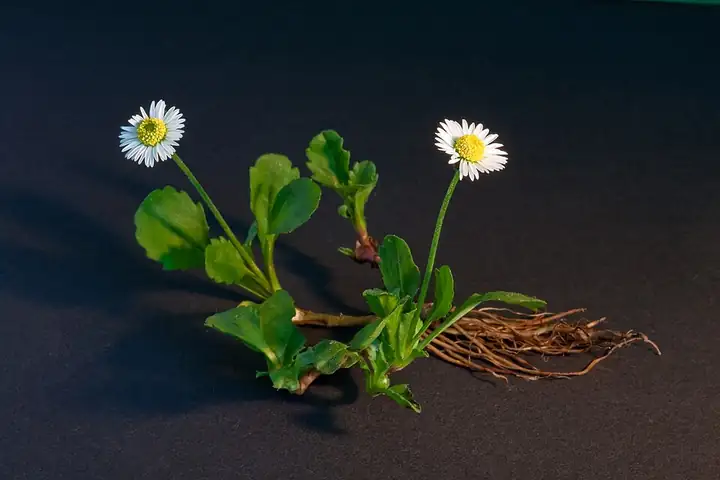
English Daisy
Bellis perennis
| Type | Broadleaf |
|---|---|
| Life cycle | Perennial |
| Family | Aster family (Asteraceae) |
| Origin | Introduced from elsewhere |
| Most common in | Pacific Northwest |
About
English daisy is a small European daisy, often planted in gardens, that escapes into lawns in cool, damp climates. It grows in flat rosettes that spread into clumps.
Also called lawn daisy, true daisy, bruisewort
How to identify it
Look for
Leaves grow in a low rosette and are spoon-shaped, broad at the tip, softly hairy and smooth or finely scalloped along the edges. Small daisy flowers with white, pink or red rays around a yellow center sit singly on leafless, hairy stalks. The crown spreads outward through short underground stems.
Where it grows
Moist lawns in cool, mild coastal climates, especially the Pacific Northwest and coastal California.
When
It blooms from about March to September.
How it spreads
Seeds, plus short creeping underground stems that widen each clump.
Most common in
| Northeast | Occasional here |
|---|---|
| Southeast | Occasional here |
| South Central | Occasional here |
| Midwest | Occasional here |
| Great Plains | Occasional here |
| Mountain West | Occasional here |
| Southwest | Occasional here |
| Pacific Northwest | Very common here |
| California | Common here |
| Alaska | Occasional here |
| Hawaii | Occasional here |
What to do, gentlest first
Start at the top. Weed killers are a last step; always read and follow the label.
Keep the lawn on the dry side Prevent
Water less often where it's a problem and keep the turf well maintained.
Dig out the crowns By hand
Carefully dig each clump with its crown and underground stems; in beds, hoeing or tilling removes it.
Digging can bring buried weed seeds to the surface.
Vinegar on small plants Organic spray
Horticultural vinegar can kill small plants; bigger clumps usually regrow.
Strong vinegar (over about 11% acetic acid) can burn skin and eyes, so wear gloves and eye protection. It browns any leaves it touches, grass included.
Triclopyr, repeated Conventional spray
In lawns, triclopyr is the main option and penoxsulam can suppress it; plan on more than one application. In beds, glyphosate works only as a careful spot treatment.
Read and follow the label. Many lawn weed killers also harm vegetables, flowers and shrubs, so don't let spray drift into beds, and keep dicamba products off the root zones of trees and shrubs.
Uses, wildlife and pets
For wildlife
Its flowers give nectar to butterflies and other pollinators.
Pets
Not listed by the ASPCA (its 'daisy' entry is chrysanthemum, a different plant that is toxic to dogs and cats). NC State lists English daisy itself as able to cause vomiting and diarrhea if eaten.
Sources
- ipm.ucanr.edu
- hortsense.cahnrs.wsu.edu
- plants.ces.ncsu.edu
- ipm.ucanr.edu
- extension.umd.edu
- plantsservices.sc.egov.usda.gov
- aspca.org
Photo: Photo: Grand-Duc / Wikimedia Commons, CC BY-SA 3.0 de (CC BY-SA 3.0 de). Photo resized for the web.

Planting dates and advice are general guidance; check with your local Cooperative Extension office for your area.