
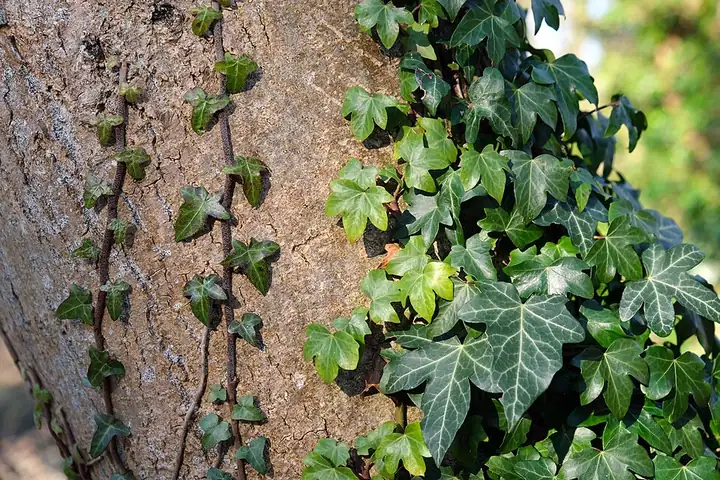
English ivy
Hedera helix
| Type | Vine |
|---|---|
| Life cycle | Perennial |
| Family | Ginseng family (Araliaceae) |
| Origin | Introduced from elsewhere |
| Most common in | Pacific Northwest |
About
An evergreen European vine planted as ground cover that escapes into woods, smothers low plants and climbs trees. Its weight and shade can weaken and eventually kill trees, and its rootlets damage mortar, wood and stucco.
Also called common ivy, ivy, branching ivy, California ivy
How to identify it
Look for
Young ground-covering stems have glossy, dark green leaves with 3 to 5 lobes and pale veins, and they cling with small aerial rootlets. Once a vine climbs high it turns 'adult': leaves become rounded or diamond-shaped without lobes, and it makes round clusters of small greenish-white flowers in fall and black berries by spring.
Look-alikes
Irish (Atlantic) ivy, Hedera hibernica, is grown the same way and is also on Pacific Northwest noxious weed lists; handle it the same way.
Where it grows
Woodlands, shady yards, fence lines, hedgerows and tree trunks; it does well in shade but grows best in sun.
When
Evergreen; adult vines flower in fall and ripen black berries over winter into spring.
How it spreads
Stems root wherever they touch soil, and birds eat the berries and drop the seeds in new places.
Most common in
| Northeast | Common here |
|---|---|
| Southeast | Common here |
| South Central | Occasional here |
| Midwest | Occasional here |
| Great Plains | Occasional here |
| Mountain West | Occasional here |
| Southwest | Occasional here |
| Pacific Northwest | Very common here |
| California | Common here |
| Alaska | Not found here |
| Hawaii | Occasional here |
Where it is regulated
Oregon and Washington list English ivy and some of its cultivars, plus Irish ivy, as noxious weeds.
What to do, gentlest first
Protect yourself first. Weed killers are a last step; always read and follow the label.
Don't plant it; swap for a native ground cover Prevent
Remove ivy before it reaches the adult, berry-making stage up high, and replace it with a ground cover that stays put.
Variegated ivy can revert to plain, fast-growing green vines.
Free the trees first By hand
Pry vines off the trunk with a flat screwdriver and cut them, clearing an ivy-free band about 3 to 4 feet high all the way around the trunk. Then pull the ground ivy back from the base.
Pulling hard on vines stuck to bark or walls can damage the surface.
Pull or rake out ground cover By hand
Pull ivy after a rain when the soil is soft; long runs come up at once. Winter work is easiest on nearby perennials. Get as much of the rooted stem as you can and check back for regrowth.
Bag berry-bearing stems; don't leave pulled stems on damp soil, where they can root again.
Glyphosate or triclopyr on new leaves Conventional spray
Spray in spring when 3 to 5 new leaves appear, before they turn waxy, on days above about 55 to 60 F; a cut-stump treatment on thick trunk vines also works. Repeat treatments are usually needed.
Read and follow the label. Many lawn and brush killers also harm garden plants, so keep spray and drift off anything you want to keep. Don't use triclopyr above 85 F, when it can drift as vapor.
Uses, wildlife and pets
For wildlife
Songbirds eat the berries, which is how the seeds spread.
Pets
Toxic to dogs, cats and horses (ASPCA lists English ivy, Hedera helix).
Sources
- plants.ces.ncsu.edu
- hgic.clemson.edu
- extension.umd.edu
- extension.oregonstate.edu
- uaex.uada.edu
- aspca.org
- aspca.org
Photo: Photo: kallerna / Wikimedia Commons, CC BY-SA 4.0 (CC BY-SA 4.0). Photo resized for the web.

Planting dates and advice are general guidance; check with your local Cooperative Extension office for your area.