
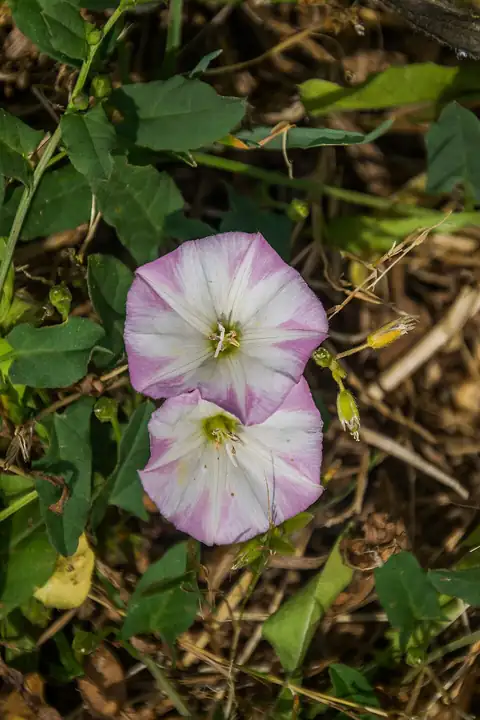
Field bindweed
Convolvulus arvensis
| Type | Vine |
|---|---|
| Life cycle | Perennial |
| Family | Morning glory family (Convolvulaceae) |
| Origin | Introduced from elsewhere |
| Most common in | Midwest, Great Plains, Mountain West, Southwest, Pacific Northwest, California |
About
Field bindweed is a twining perennial vine from Europe and Asia that is counted among the worst weeds in North America. Its roots run many feet deep and regrow from tiny pieces, so it can smother garden plants for years.
Also called small bindweed, lesser bindweed, common bindweed, wild morning glory
How to identify it
Look for
Look for arrowhead-shaped leaves about 1/2 to 2 inches long on thin stems that trail along the ground or twist around other plants. The white to pink trumpet flowers are about 1 inch across and close later each day. Seedlings have nearly square seed leaves with a shallow notch at the tip.
Look-alikes
Hedge bindweed has bigger leaves and flowers (1.5 to 3 inches) with two large green bracts hugging the flower base; field bindweed's bracts are tiny and don't cover the base of the flower. Garden morning glories (Ipomoea) have larger, often colorful flowers, heart-shaped leaves and thicker, often hairy stems.
Where it grows
Gardens, lawns, driveways, fence lines, orchards and farm fields, especially in sunny spots and heavy clay soil; it tolerates drought.
When
Shoots come up in spring from roots, and flowers open from about April through October.
How it spreads
Spreads by deep roots and rhizomes (root pieces as short as 2 inches regrow, and one plant can spread over 10 feet in a season) and by seeds that can stay alive in soil for 50 years or more.
Most common in
| Northeast | Common here |
|---|---|
| Southeast | Common here |
| South Central | Common here |
| Midwest | Very common here |
| Great Plains | Very common here |
| Mountain West | Very common here |
| Southwest | Very common here |
| Pacific Northwest | Very common here |
| California | Very common here |
| Alaska | Occasional here |
| Hawaii | Occasional here |
Where it is regulated
Listed as a noxious weed in Colorado (List C) and Washington (Class C).
What to do, gentlest first
Start at the top. Weed killers are a last step; always read and follow the label.
Stop it before it settles in Prevent
Buy clean seed, soil and nursery plants, and pull seedlings in their first 3 to 4 weeks, before they form perennial roots. Never let vines flower and set seed.
Pull or hoe the shoots again and again By hand
Pulling will not kill the deep roots in one go, but cutting shoots every week or two for several seasons starves them. Shade from trees and shrubs also weakens it.
Don't till infested soil; it chops roots into many new plants.
Black plastic or landscape fabric Barrier
Cover the patch with black plastic or tough landscape fabric, overlapping the edges so no stems escape. Expect to leave it 3 to 5 years for the roots to die.
Check edges and planting holes; stems sneak through any gap.
Bindweed gall mite Natural enemies
A tiny mite (Aceria malherbae) makes galls on new growth, stunting the vines and cutting flowering; Colorado sells releases through its Request-a-Bug program. It works slowly, over two to three years.
Systemic herbicide on growing vines Conventional spray
Glyphosate spot-sprayed on actively growing vines in beds, or 2,4-D plus dicamba in lawns, moves down into roots; repeat treatments are needed. It takes 2 to 3 weeks to see results.
Read and follow the label; many lawn and brush herbicides also kill garden plants. Keep glyphosate off the leaves of plants you want to keep.
Uses, wildlife and pets
Pets
Not listed by the ASPCA (its toxic morning glory listing covers Ipomoea, a different genus).
Sources
- ipm.ucanr.edu
- ipm.ucanr.edu
- extension.psu.edu
- ag.colorado.gov
- ag.colorado.gov
- nwcb.wa.gov
- plantsservices.sc.egov.usda.gov
- aspca.org
- aspca.org
Photo: Photo: Krzysztof Golik / Wikimedia Commons, CC BY-SA 4.0 (CC BY-SA 4.0). Photo resized for the web.

Planting dates and advice are general guidance; check with your local Cooperative Extension office for your area.