
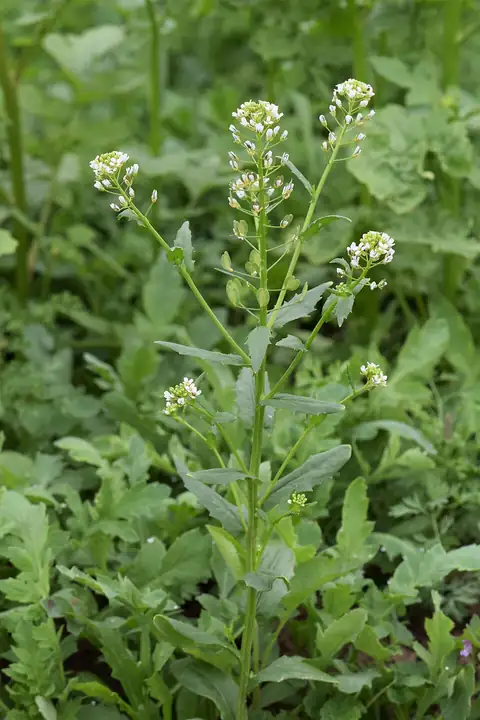
Field pennycress
Thlaspi arvense
| Type | Broadleaf |
|---|---|
| Life cycle | Annual |
| Family | Mustard family (Brassicaceae) |
| Origin | Introduced from elsewhere |
| Most common in | Midwest, Great Plains, Mountain West |
About
A mustard-family annual with tiny white flowers and round, flat, winged pods that look like little coins. The whole plant smells strongly (often called garlicky) when crushed, and cows that eat it give off-flavored milk.
Also called fanweed, stinkweed, frenchweed, pennycress
How to identify it
Look for
Starts as a rosette of hairless leaves, then sends up a ribbed stem 6-30 inches tall with alternate leaves. Clusters of tiny four-petal white flowers become round, flat pods about 1/2 inch across with papery wings and a notch at the top that is deeper than it is wide. Crushed plants have a strong, unpleasant smell.
Look-alikes
Shepherd's purse has smaller heart- or triangle-shaped pods and mostly leafless flower stalks; thoroughwort pennycress has smaller seeds in pods with a wider notch.
Where it grows
Fields, gardens, roadsides and other disturbed ground on almost any soil; it does not tolerate shade.
When
Sprouts mostly in spring with a smaller wave in fall (fall plants overwinter as rosettes); spring plants bloom 5-7 weeks after emerging and ripen seed within about two weeks.
How it spreads
By seed; plants make about 1,600-15,000 seeds, which can persist 17-30 years in undisturbed soil.
Most common in
| Northeast | Common here |
|---|---|
| Southeast | Occasional here |
| South Central | Occasional here |
| Midwest | Very common here |
| Great Plains | Very common here |
| Mountain West | Very common here |
| Southwest | Occasional here |
| Pacific Northwest | Common here |
| California | Occasional here |
| Alaska | Occasional here |
| Hawaii | Not found here |
Where it is regulated
It is a restricted noxious weed seed under state seed laws in states including Indiana and Kansas.
What to do, gentlest first
Start at the top. Weed killers are a last step; always read and follow the label.
Keep beds planted and rework before planting Prevent
A healthy, dense planting leaves it little room. Before sowing, stir the seedbed again to sprout and kill a flush of seedlings.
Pull or hoe before pods form By hand
The shallow roots make it easy to hand-pull or hoe. Mowing alone isn't reliable, since cut plants branch and regrow.
Winter rye cover crop Natural enemies
A dense winter cover crop of rye suppresses it; turn the rye under in spring before the pennycress goes to seed.
Spot-treat when needed Conventional spray
In landscape beds, glyphosate as a spot treatment only; in lawns, 2,4-D products.
Read and follow the label. Many lawn weed killers also kill vegetables and flowers, and glyphosate harms any plant it touches.
Uses, wildlife and pets
For wildlife
Small bees and flies visit the flowers, and some white butterflies and moths lay eggs on the leaves.
Pets
Listed by the ASPCA as toxic to horses (colic, diarrhea, skin irritation); not listed for dogs or cats. Large amounts can poison cattle and taint their milk and meat.
Sources
- cals.cornell.edu
- hortsense.cahnrs.wsu.edu
- plants.ces.ncsu.edu
- plantsservices.sc.egov.usda.gov
- aspca.org
- ams.usda.gov
Photo: Photo: Krzysztof Ziarnek, Kenraiz / Wikimedia Commons, CC BY-SA 4.0 (CC BY-SA 4.0). Photo resized for the web.

Planting dates and advice are general guidance; check with your local Cooperative Extension office for your area.