
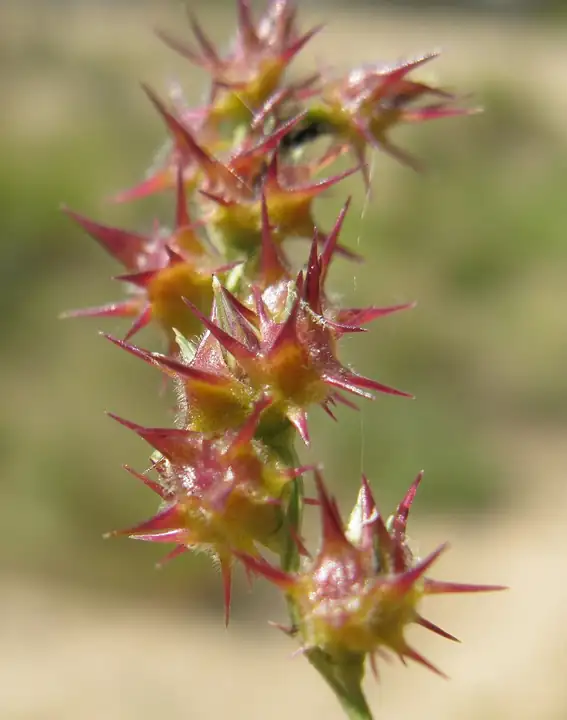
Field sandbur
Cenchrus spinifex
| Type | Grass |
|---|---|
| Life cycle | Summer annual |
| Family | Grass family (Poaceae) |
| Origin | Native to the US |
| Most common in | Southeast, South Central, Great Plains |
About
A native warm-season grass best known for its spiny burs, which stab bare feet, pet paws and clothing. It thrives in thin lawns on dry, sandy soil.
Also called sandbur, sandspur, grassbur, grass bur, sticker weed
How to identify it
Look for
A low, spreading grass with flattened, often purplish stems and rough-feeling leaves; the ligule is a narrow fringe of hairs. Spikes 1 to 3 inches long hold clusters of round, hairy burs, each covered in dozens of sharp spines.
Look-alikes
Southern sandbur and longspine sandbur are close relatives with the same painful burs and the same care.
Where it grows
Thin lawns, roadsides, fields, farmyards and disturbed ground, especially on dry, sandy soil.
When
Sprouts in spring, forms burs in summer, and usually dies at frost, though some plants regrow from the roots as short-lived perennials.
How it spreads
Spreads by burs holding 1 to 3 seeds each that hitch rides on animals, shoes and clothes, and the seeds can wait in the soil until conditions suit them.
Most common in
| Northeast | Occasional here |
|---|---|
| Southeast | Very common here |
| South Central | Very common here |
| Midwest | Common here |
| Great Plains | Very common here |
| Mountain West | Occasional here |
| Southwest | Common here |
| Pacific Northwest | Occasional here |
| California | Occasional here |
| Alaska | Not found here |
| Hawaii | Not found here |
What to do, gentlest first
Start at the top. Weed killers are a last step; always read and follow the label.
Thicken the lawn Prevent
Sandbur takes over where grass is weak and soil is sandy and dry. Feed and water to keep turf dense.
Pull plants before burs form By hand
Pull plants with gloved hands, ideally before burs form. Bag any burs so they don't reseed.
Wear sturdy gloves; the spines are sharp.
Early-spring pre-emergent Conventional spray
Apply a pre-emergent such as pendimethalin in early spring, before seeds sprout, and water it in with about 1/2 inch of water.
Read and follow the label. Many lawn herbicides kill garden plants, so keep spray and drift off beds and vegetables.
Uses, wildlife and pets
Pets
Not listed as toxic to dogs, cats or horses by the ASPCA. The sharp burs cling to fur and can pierce skin, causing pain and sometimes infection.
Sources
- extension.okstate.edu
- aggieturf.tamu.edu
- aggieturf.tamu.edu
- hgic.clemson.edu
- plantsservices.sc.egov.usda.gov
- aspca.org
- aspca.org
- aspca.org
Photo: Photo: Macleay Grass Man / Wikimedia Commons, CC BY 2.0 (CC BY 2.0). Photo resized for the web.

Planting dates and advice are general guidance; check with your local Cooperative Extension office for your area.