
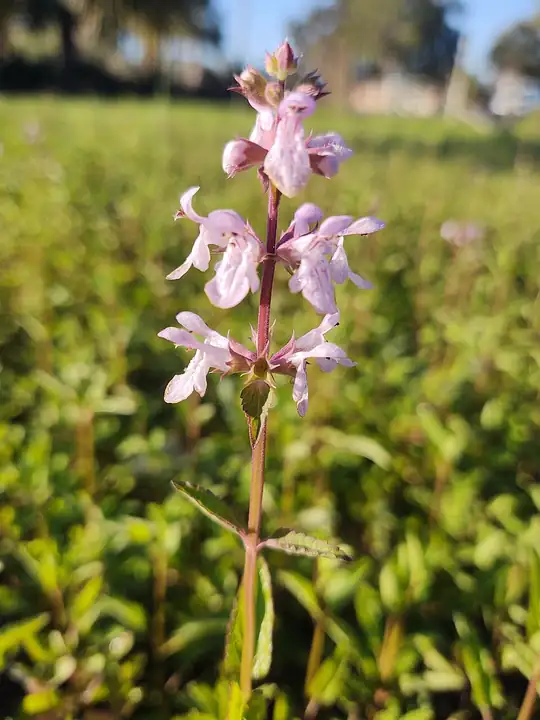
Florida betony
Stachys floridana
| Type | Broadleaf |
|---|---|
| Life cycle | Perennial |
| Family | Mint family (Lamiaceae) |
| Origin | Native to the US |
| Most common in | Southeast |
About
Florida betony is a cool-season mint relative, probably native only to Florida, that has spread through lawns and beds across the Southeast. It grows from crunchy white tubers, so pulling the tops rarely gets rid of it and control can take two years.
Also called rattlesnake weed, Florida hedgenettle, hedge nettle
How to identify it
Look for
Look for hairy, square stems 1 to 2 feet tall with opposite, lance-shaped leaves about 2 inches long and lightly toothed edges. Spring flowers are small white-to-pink trumpets with purple spots. Dig one up: the white, segmented tuber looks like a rattlesnake's rattle.
Look-alikes
Its square stems and opposite leaves look like other mint-family plants. Digging up the white, rattle-shaped tuber is the surest check.
Where it grows
Lawns and loosened landscape beds in sun or part shade, in wet or dry soil; it also moves in with sod and potted plants.
When
It sprouts from tubers in the cool, moist fall, grows through winter, flowers from late spring into early summer, makes new tubers, then goes dormant in summer heat.
How it spreads
Mostly by tubers and rhizomes (small rhizome pieces can sprout), and also by seed.
Most common in
| Northeast | Not found here |
|---|---|
| Southeast | Very common here |
| South Central | Common here |
| Midwest | Not found here |
| Great Plains | Not found here |
| Mountain West | Not found here |
| Southwest | Not found here |
| Pacific Northwest | Not found here |
| California | Not found here |
| Alaska | Not found here |
| Hawaii | Not found here |
What to do, gentlest first
Start at the top. Weed killers are a last step; always read and follow the label.
Keep turf thick and check new sod and plants Prevent
Good fertilizing, watering and mowing help turf crowd it out. Look over sod and potted plants before planting, since tubers can hitchhike in.
Dig out the whole tuber By hand
In beds, dig and sift the soil so you get every tuber, not just the top. Repeat whenever new shoots appear, especially in fall and spring.
Tubers left in the soil regrow.
Thick coarse mulch Barrier
UGA suggests 2 to 4 inches of coarse mulch such as pine straw, over landscape fabric, to slow it down in beds.
Clemson notes mulch and fabric alone often fail against this weed, so keep digging too.
Broadleaf lawn herbicide in cool months Conventional spray
In lawns, products with 2,4-D, dicamba and mecoprop (MCPP) work in fall and early spring; atrazine is an option on centipedegrass and St. Augustinegrass. In beds, spot-spray or wipe glyphosate on the weed around flowering, and expect to repeat spring and fall for up to 2 years.
Read and follow the label. Many lawn weed killers also kill garden plants, so keep spray and drift off beds and vegetables. Clemson advises not spraying lawns above 85 F or during warm-season grass green-up.
Uses, wildlife and pets
Edible?
NC State and UGA Extension note the tubers are edible, with a crisp, mild, slightly sweet taste. Only eat tubers you are sure of, from ground that has not been sprayed.
Not 100% sure? Don't eat it. Never pick from ground that may have been sprayed, or along roads and railways.
Pets
Not listed by the ASPCA.
Sources
Photo: Photo: Lauren Whitehurst / Wikimedia Commons, CC0 (CC0). Photo resized for the web.

Planting dates and advice are general guidance; check with your local Cooperative Extension office for your area.