
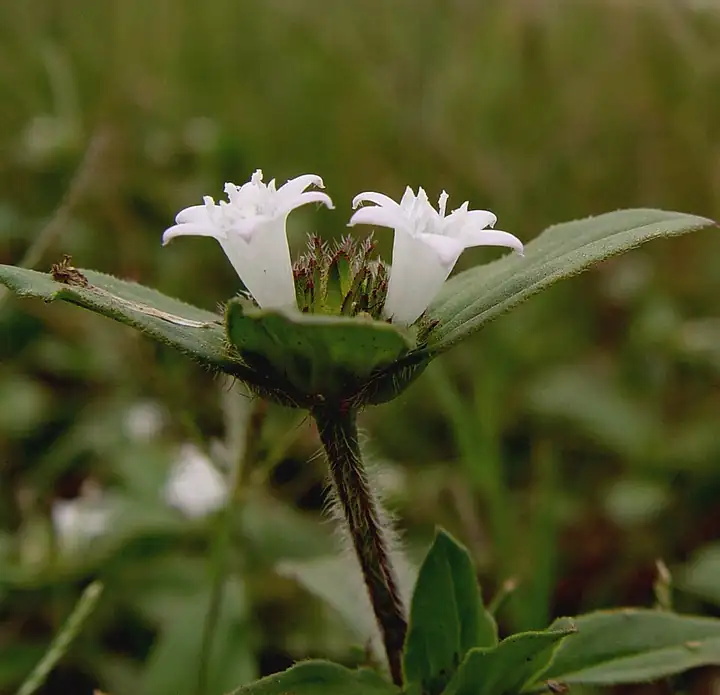
Florida pusley
Richardia scabra
| Type | Broadleaf |
|---|---|
| Life cycle | Summer annual |
| Family | Madder family (Rubiaceae) |
| Origin | Native to the US |
| Most common in | Southeast |
About
A low, hairy summer annual of Southern lawns and gardens with clusters of small white star-shaped flowers. It is very drought tolerant, takes over thin, dry turf, and reseeds heavily.
Also called pusley, rough Mexican clover
How to identify it
Look for
Branched, hairy stems lie flat where mowed or stand up to about 2.5 feet elsewhere, and they do not root at the joints. Leaves are opposite, oval to lance-shaped, 1-3 inches long, hairy and somewhat thick. Small white tubular flowers with six lobes form tight clusters at the branch tips, and the root is a shallow taproot.
Look-alikes
Brazil pusley is very similar but can form a thick, perennial rootstock, and its fruits have hair-like outgrowths instead of small wart-like bumps.
Where it grows
Thin warm-season lawns, flower beds, gardens, vegetable fields, pastures and waste areas, often in sandy soil.
When
Sprouts in warm weather (about 68-95°F) and can germinate soon after seeds drop; it flowers through the warm season, and in Florida it can bloom year-round.
How it spreads
By seed; seeds sprout only from the top 1/5 inch or so of soil, and a single plant can quickly turn into a patch.
Most common in
| Northeast | Occasional here |
|---|---|
| Southeast | Very common here |
| South Central | Common here |
| Midwest | Occasional here |
| Great Plains | Occasional here |
| Mountain West | Occasional here |
| Southwest | Occasional here |
| Pacific Northwest | Occasional here |
| California | Occasional here |
| Alaska | Not found here |
| Hawaii | Occasional here |
What to do, gentlest first
Start at the top. Weed killers are a last step; always read and follow the label.
Keep turf thick and watered Prevent
Mow at the right height for your grass, never removing more than a third of the blade at once, and water during long dry spells. A heavy pusley patch can signal nematode trouble, so ask your county Extension office about a soil test.
Hand-pull By hand
Its shallow taproot makes hand-pulling a good option; get plants before they flower.
Mulch beds Barrier
Seedlings cannot push through plastic mulch, and seeds need to be almost at the surface to sprout, so covering bare soil keeps it down.
Grow a tall cover crop Natural enemies
During fallow periods, cover crops with tall canopies compete with pusley.
Pre-emergent in beds Conventional spray
Pendimethalin is among the pre-emergent herbicides that control Florida pusley; post-emergent glyphosate gives poor control.
Read and follow the label. Many lawn weed killers also kill vegetables and flowers, and glyphosate harms any plant it touches.
Uses, wildlife and pets
Pets
Not listed by the ASPCA.
Sources
- hgic.clemson.edu
- weedid.missouri.edu
- turf.caes.uga.edu
- ask.ifas.ufl.edu
- plantsservices.sc.egov.usda.gov
- aspca.org
Photo: Photo: Florimagix / Wikimedia Commons, CC BY-SA 4.0 (CC BY-SA 4.0). Photo resized for the web.

Planting dates and advice are general guidance; check with your local Cooperative Extension office for your area.