
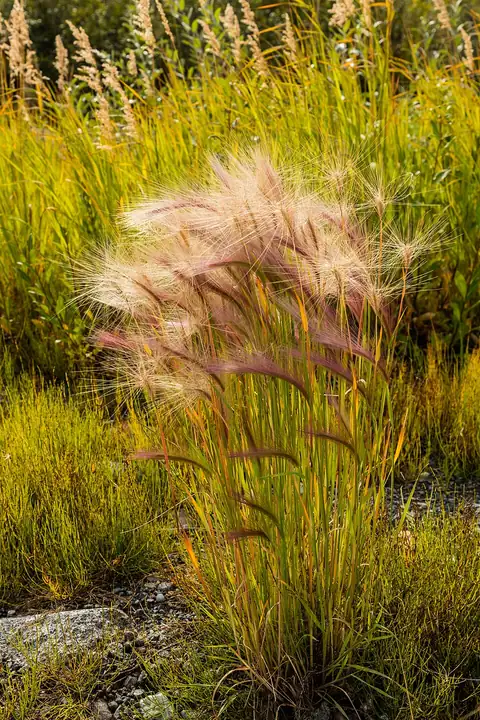
Foxtail barley
Hordeum jubatum
| Type | Grass |
|---|---|
| Life cycle | Perennial |
| Family | Grass family (Poaceae) |
| Origin | Native to the US |
| Most common in | Great Plains, Mountain West |
About
Foxtail barley is a native, short-lived bunchgrass with pretty, silky seedheads that are a real hazard for pets. The long, barbed awns break off and work into dogs' and cats' ears, eyes, noses and paws, and also injure livestock.
Also called foxtail, squirreltail, skunktail
How to identify it
Look for
It grows in bluish-green clumps up to about 2 feet tall. The nodding, feathery seedhead is up to 5 inches long, packed with fine, barbed awns 1 to 2.5 inches long. As it ripens, pieces break off from the top so the head gets shorter.
Look-alikes
UC IPM notes hare barley (it has clear ear-like flaps where the leaf meets the stem) and volunteer wheat look similar. Medusahead looks similar too, but its awns stay attached to the seed when it falls.
Where it grows
Moist and salty or alkaline soils: ditches, wet meadows, seasonally flooded spots, pastures, roadsides and bare ground with little competition.
When
It greens up in spring and sets seed from late May through August, earlier at low elevations; the dry heads are most dangerous to pets in summer.
How it spreads
By seed that breaks apart and sticks to fur and clothing, and the clumps widen by tillering.
Most common in
| Northeast | Occasional here |
|---|---|
| Southeast | Occasional here |
| South Central | Occasional here |
| Midwest | Common here |
| Great Plains | Very common here |
| Mountain West | Very common here |
| Southwest | Common here |
| Pacific Northwest | Common here |
| California | Common here |
| Alaska | Common here |
| Hawaii | Not found here |
What to do, gentlest first
Start at the top. Weed killers are a last step; always read and follow the label.
Dry out wet spots and fill bare ground Prevent
Improve drainage so soil isn't saturated in spring, and reseed bare or salty spots with competitive grasses.
Mow early or dig out clumps before seed By hand
Mow in spring before seedheads form, and dig out scattered clumps, then reseed. Remove foxtail plants from yards where pets play.
Wear gloves and bag seedheads so the awns don't spread.
Early grazing on pasture Natural enemies
Colorado State notes intense grazing early in the season, before seed forms, can reduce it.
Don't graze or feed hay once awns form.
Spot-spray glyphosate Conventional spray
Spot-treat scattered plants with glyphosate while green and growing, then reseed.
Read and follow the label. Many lawn weed killers also kill garden plants, so keep spray and drift off beds and vegetables. Glyphosate kills lawn grass too.
Uses, wildlife and pets
Pets
Not listed by the ASPCA. Its awns can lodge in the skin, mouth, nose and eyes of animals, and hay with it shouldn't be fed. Check dogs and cats after walks: UC Davis vet school says foxtail-type seeds work into ears, eyes, noses, paws and skin. Watch for head shaking, sneezing, pawing, limping or eye swelling, and see a vet if a seed is embedded.
Sources
- extension.colostate.edu
- ipm.ucanr.edu
- crops.extension.iastate.edu
- healthtopics.vetmed.ucdavis.edu
- plantsservices.sc.egov.usda.gov
- aspca.org
Photo: Photo: Diego Delso / Wikimedia Commons, CC BY-SA 4.0 (CC BY-SA 4.0). Photo resized for the web.

Planting dates and advice are general guidance; check with your local Cooperative Extension office for your area.