
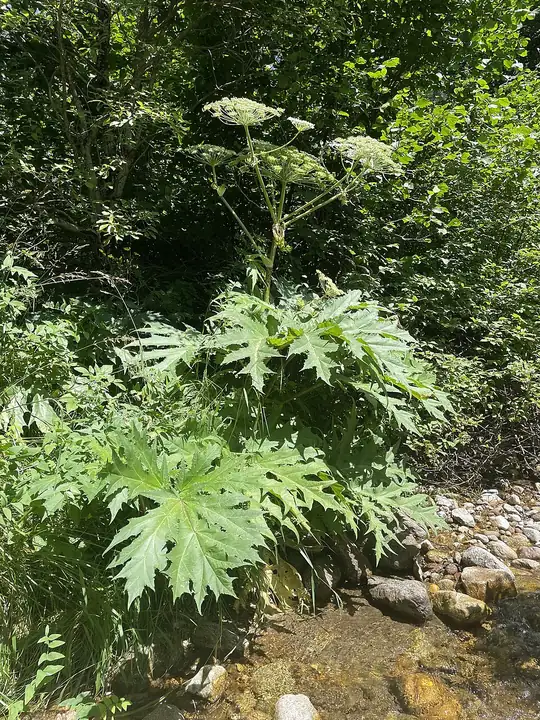
Giant hogweed
Heracleum mantegazzianum
| Type | Broadleaf |
|---|---|
| Life cycle | Perennial |
| Family | Carrot family (Apiaceae) |
| Origin | Introduced from elsewhere |
About
A huge carrot-family plant from the Caucasus whose sap, with sunlight, causes severe burns, blisters and even blindness. It is a federal noxious weed: if you think you've found it, don't touch it, and report it.
Also called cartwheel-flower, hogweed
How to identify it
Look for
Plants reach 7 to 14 feet or more, with hollow stems 2 to 4 inches thick covered in purple blotches and coarse white hairs. Deeply cut, jagged leaves can be 5 feet across, and in summer it carries flat-topped white flower clusters up to 2½ feet wide. It usually grows for a few years as leaves only, then flowers once and dies.
Look-alikes
Native cow parsnip is smaller (5 to 8 feet), with stems 1 to 2 inches thick, fine hairs and flower heads about a foot wide. Poison hemlock has fern-like leaves and smooth stems, wild parsnip has yellow flowers, and Queen Anne's lace is only 1 to 3 feet tall; angelica and elderberry lack the coarse stem hairs.
Where it grows
Stream and river banks, damp roadsides, field edges, woodland edges and yards, often where it was once planted as an ornamental.
When
Leaves come up early in spring; plants bloom from late June to mid July, then set seed and die.
How it spreads
One plant makes thousands of seeds, often around 20,000, which float along waterways and can survive in the soil for several years; people spread it by moving seeds.
Most common in
| Northeast | Common here |
|---|---|
| Southeast | Occasional here |
| South Central | Not found here |
| Midwest | Occasional here |
| Great Plains | Not found here |
| Mountain West | Not found here |
| Southwest | Not found here |
| Pacific Northwest | Occasional here |
| California | Not found here |
| Alaska | Not found here |
| Hawaii | Not found here |
Where it is regulated
A federal noxious weed, illegal to move between states without a permit; also listed by New York, Virginia (Tier 1), Ohio and Washington (Class A), among others.
What to do, gentlest first
Protect yourself first. Weed killers are a last step; always read and follow the label.
Report it and keep away Prevent
Take photos from a distance and report the location to your state agriculture or environmental agency or county extension office. Don't move plants or seeds.
Keep children and pets away. It is illegal to move this federal noxious weed.
Root cutting by trained crews By hand
Crews cut the root below ground and remove flower heads before seed forms, starting early in spring when plants are small.
Not a DIY job: sap can splash several feet. Never use a string trimmer or brush cutter. Work in shade or after sunset in full waterproof gear.
Grazing on large stands Natural enemies
Sheep and goats grazing several times a year can wear down dense stands under an agency or professional plan.
Glyphosate or triclopyr by a licensed applicator Conventional spray
Applied by trained applicators to young plants in spring, with follow-up for 3 to 5 years until the seed bank is gone.
Read and follow the label. Many lawn and brush herbicides also kill garden plants, so keep spray and drift off anything you want to keep.
Uses, wildlife and pets
Pets
Not listed by the ASPCA under its own name; the ASPCA lists its close relative cow parsnip as toxic to dogs, cats and horses because its sap causes sunburn-like skin damage.
Sources
- dec.ny.gov
- dec.ny.gov
- extapps.dec.ny.gov
- pubs.ext.vt.edu
- ohioline.osu.edu
- nwcb.wa.gov
- fs.usda.gov
- invasivespeciesinfo.gov
- aspca.org
Photo: Photo: anastasiiamerkulova / Wikimedia Commons, CC BY 4.0 (CC BY 4.0). Photo resized for the web.

Planting dates and advice are general guidance; check with your local Cooperative Extension office for your area.