
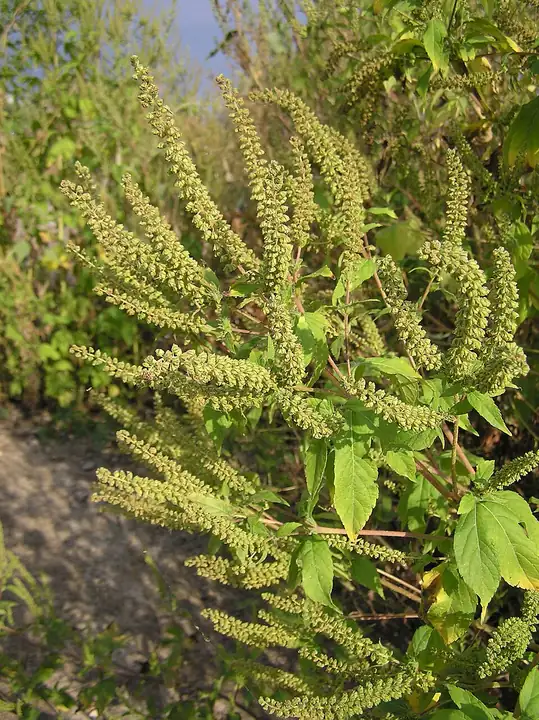
Giant ragweed
Ambrosia trifida
| Type | Broadleaf |
|---|---|
| Life cycle | Summer annual |
| Family | Aster family (Asteraceae) |
| Origin | Native to the US |
| Most common in | Midwest |
About
Giant ragweed is a huge native annual, usually 3 to 12 feet tall, that shades out anything near it. Its wind-blown pollen causes severe hay fever, and some farm populations resist glyphosate and other herbicides.
Also called great ragweed
How to identify it
Look for
Large, rough, sandpapery leaves grow in opposite pairs and are usually split into 3 to 5 deep lobes like a hand. Stems are tall, stout and rough. Slender spikes of green male flowers top the plant in summer, and the seed is a large, crown-shaped husk about 1/3 inch long.
Look-alikes
Young plants whose first leaves aren't lobed can look like cocklebur or sunflower; common ragweed seedlings look similar but are less than half the size.
Where it grows
Rich, moist bottomland, stream banks, field edges, fencerows and gardens, especially in the Corn Belt.
When
One of the first summer annuals to sprout, in early to late spring; it flowers in midsummer and ripens seed in late summer.
How it spreads
Seed only: from about 150 seeds per crowded plant to a few thousand on open-grown ones; most seeds are gone from the soil within two years.
Most common in
| Northeast | Common here |
|---|---|
| Southeast | Common here |
| South Central | Common here |
| Midwest | Very common here |
| Great Plains | Common here |
| Mountain West | Occasional here |
| Southwest | Occasional here |
| Pacific Northwest | Occasional here |
| California | Occasional here |
| Alaska | Not found here |
| Hawaii | Not found here |
Where it is regulated
Listed as a noxious weed in Delaware and Illinois.
What to do, gentlest first
Start at the top. Weed killers are a last step; always read and follow the label.
Cut or pull before the pollen and seed Prevent
Remove plants before they flower in midsummer. Because few seeds last more than two years in the soil, two seasons of stopping seed can clear a patch.
The pollen causes severe hay fever in sensitive people.
Pull seedlings early By hand
Pull or hoe in spring while plants are small; big plants have tough stems and are much harder to remove.
Wear gloves and long sleeves; the leaves and stems are rough.
Mulch beds Barrier
Seeds sprout best from half an inch to 2 inches deep and rarely from deeper than 4 inches, so a thick mulch over bare soil helps keep seedlings down.
Burn down seedlings with a contact spray Organic spray
Horticultural vinegar (acetic acid), fatty-acid soap, pelargonic acid or clove-oil sprays burn what they touch within hours. They work best on young seedlings in warm, sunny weather, and you will need to repeat, because they don't move into roots and bigger plants regrow.
They kill any plant they touch, so shield crops. Strong vinegar can burn skin and eyes; wear goggles and gloves and follow the label.
Spot spray young plants Conventional spray
In lawns, a broadleaf herbicide such as 2,4-D; in beds, spot spray glyphosate on the weed only. Some farm populations resist glyphosate and ALS herbicides, so pull any survivors.
Read and follow the label. Many lawn weed killers also kill or damage vegetables and flowers, so keep spray and drift off garden plants.
Uses, wildlife and pets
For wildlife
Rodents eat large numbers of the fallen seeds over winter (SARE).
Pets
Not listed by the ASPCA.
Sources
- sare.org
- crops.extension.iastate.edu
- blogs.cdfa.ca.gov
- agriculture.delaware.gov
- dnr.illinois.gov
- plantsservices.sc.egov.usda.gov
- ipm.ucanr.edu
- ucanr.edu
Photo: Photo: Le.Loup.Gris / Wikimedia Commons, CC BY-SA 3.0 (CC BY-SA 3.0). Photo resized for the web.

Planting dates and advice are general guidance; check with your local Cooperative Extension office for your area.