
Goosegrass
Eleusine indica
| Type | Grass |
|---|---|
| Life cycle | Summer annual |
| Family | Grass family (Poaceae) |
| Origin | Introduced from elsewhere |
| Most common in | Southeast, South Central, Hawaii |
About
A tough summer annual grass that forms flat, wagon-wheel clumps in hard, trampled soil. It sprouts weeks after crabgrass, so an early crabgrass pre-emergent often misses it.
Also called silver crabgrass, wiregrass, Indian goosegrass, goose grass
How to identify it
Look for
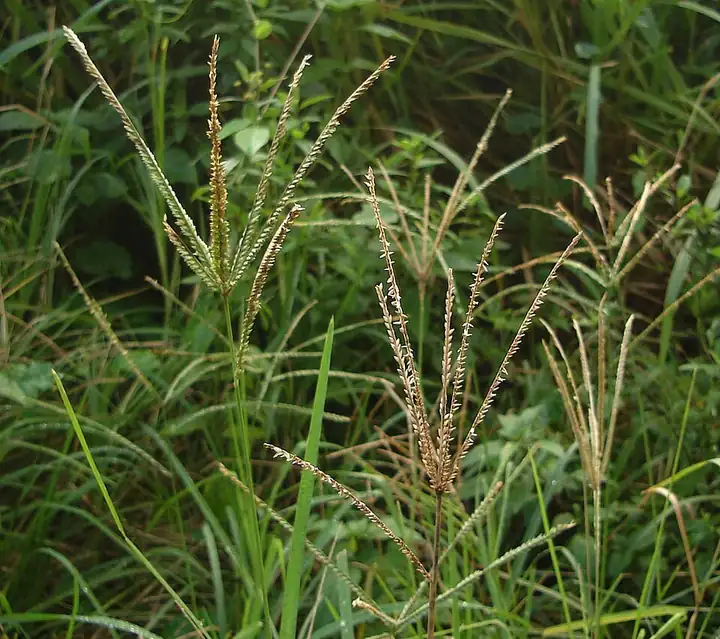
A low, flat rosette with a silvery-white center where the flattened, slightly fleshy stems meet. Leaves are mostly hairless, the ligule is short and jagged, and stems do not root at the joints. Seedheads have 2 to 6 stiff spikes at the stem tip with seeds lined up like a zipper.
Look-alikes
Crabgrass looks similar but lacks the white center and roots at its lower joints. Dallisgrass is a clumping perennial with longer, drooping seedhead branches.
Where it grows
Compacted, heavily walked spots: paths, play areas, sports fields, lawn edges, driveway cracks and garden beds that get summer water.
When
Sprouts in late spring once soil reaches 60 to 65 degrees F, weeks after crabgrass, flowers from July to October, and dies at the first frost.
How it spreads
Spreads by seed only, and it can make seed even when mowed short.
Most common in
| Northeast | Common here |
|---|---|
| Southeast | Very common here |
| South Central | Very common here |
| Midwest | Common here |
| Great Plains | Occasional here |
| Mountain West | Occasional here |
| Southwest | Common here |
| Pacific Northwest | Occasional here |
| California | Common here |
| Alaska | Not found here |
| Hawaii | Very common here |
What to do, gentlest first
Start at the top. Weed killers are a last step; always read and follow the label.
Loosen compacted soil and thicken the lawn Prevent
Core-aerate hard, trampled areas and keep turf dense with good mowing and feeding. Goosegrass loses out where soil is loose and grass is thick.
Pull clumps before they seed By hand
Pull small plants with gloved hands or a weeding tool before seedheads form. Older clumps are tough, so dig them rather than yank.
Mulch garden beds Barrier
Keep a thick layer of wood chips or compost on bed soil to block the light seeds need to sprout.
Time the pre-emergent later Conventional spray
Because goosegrass sprouts after crabgrass, apply a pre-emergent such as prodiamine, dithiopyr or pendimethalin 3 to 4 weeks after your crabgrass date, or plan a second application. Post-emergent products vary in how well they work on it, so check that goosegrass is on the label.
Read and follow the label. Many lawn herbicides kill garden plants, so keep spray and drift off beds and vegetables.
Uses, wildlife and pets
Pets
Not listed as toxic to dogs, cats or horses by the ASPCA.
Sources
- ipm.ucanr.edu
- content.ces.ncsu.edu
- extension.psu.edu
- hgic.clemson.edu
- ipm.ucanr.edu
- plantsservices.sc.egov.usda.gov
- aspca.org
- aspca.org
- aspca.org
Photo: Photo: Tauʻolunga / Wikimedia Commons, CC BY-SA 3.0 (CC BY-SA 3.0). Photo resized for the web.

Planting dates and advice are general guidance; check with your local Cooperative Extension office for your area.