
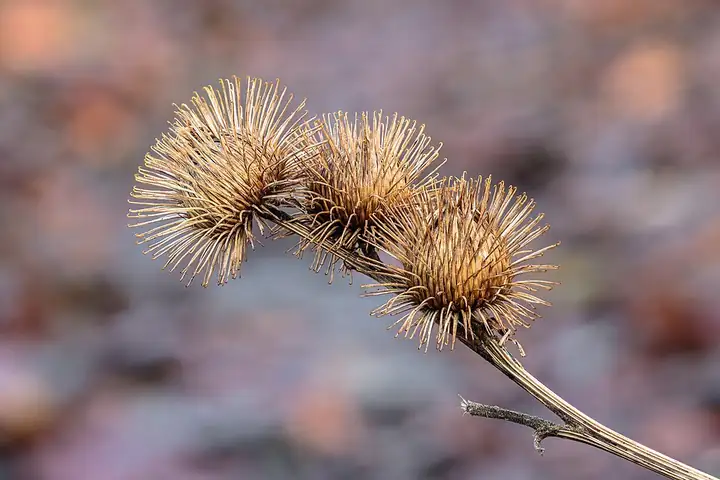
Greater burdock
Arctium lappa
| Type | Broadleaf |
|---|---|
| Life cycle | Biennial |
| Family | Aster family (Asteraceae) |
| Origin | Introduced from elsewhere |
| Most common in | Northeast |
About
Greater burdock is a large Eurasian biennial with huge leaves and hooked burs that cling to clothes and fur. Its deep taproot makes it hard to pull, and the burs are a nuisance for pets and livestock.
Also called great burdock, edible burdock, gobo, beggar's buttons, burdock
How to identify it
Look for
The first year it makes a big rosette of heart-shaped leaves, often more than 6 inches long and wide, rough on top and woolly underneath. The second year it grows 2 to 10 feet tall with purple, thistle-like flower heads over 1.2 inches wide in flat-topped clusters, which ripen into round burs covered in hooked bracts. The lower leaf stalks are solid, and the fleshy taproot can reach 3 feet deep.
Look-alikes
Common burdock (Arctium minus) is more widespread and very similar, but has hollow lower leaf stalks and smaller flower heads (under 1.2 inches) on short stalks along the stem.
Where it grows
Roadsides, stream banks, old fields, pastures, woodland and lawn edges, vacant lots and neglected corners, in rich, moist soil.
When
Rosettes form the first year; plants bolt and flower in summer and fall of the second year, then die after setting burs.
How it spreads
Only by seed; burs hitch rides on clothing and fur (a burdock plant can make about 15,000 seeds, which live only a few years in soil).
Most common in
| Northeast | Very common here |
|---|---|
| Southeast | Occasional here |
| South Central | Occasional here |
| Midwest | Common here |
| Great Plains | Occasional here |
| Mountain West | Occasional here |
| Southwest | Occasional here |
| Pacific Northwest | Occasional here |
| California | Occasional here |
| Alaska | Not found here |
| Hawaii | Occasional here |
What to do, gentlest first
Start at the top. Weed killers are a last step; always read and follow the label.
Stop the burs Prevent
Remove plants before they flower so no new burs form; the seed bank is short-lived, so a few years of no seeding clears it.
Dig out the whole taproot By hand
Dig first-year rosettes or young plants and remove the entire taproot. Mowing works only after plants bolt but before they flower.
Wear gloves and long sleeves; bur bristles irritate skin and eyes. Bag burs; don't compost them.
Broadleaf herbicide on rosettes Conventional spray
Herbicides with 2,4-D, dicamba or metsulfuron control burdock.
Read and follow the label; many lawn and brush herbicides also kill garden plants.
Uses, wildlife and pets
Edible?
The young taproot is a vegetable called gobo in Japan and Korea, and young leaves and immature flower stalks are also eaten. Harvest first-year roots only, be sure of the ID, and never gather from sprayed or roadside ground.
Not 100% sure? Don't eat it. Never pick from ground that may have been sprayed, or along roads and railways.
For wildlife
Bees and other pollinators visit the flowers, but the burs can trap small birds and bats.
Pets
Not listed by the ASPCA. The burs tangle in fur, and their fine bristles can irritate the eyes, skin and airways of people, dogs and horses.
Sources
Photo: Photo: Famberhorst / Wikimedia Commons, CC BY-SA 4.0 (CC BY-SA 4.0). Photo resized for the web.

Planting dates and advice are general guidance; check with your local Cooperative Extension office for your area.