
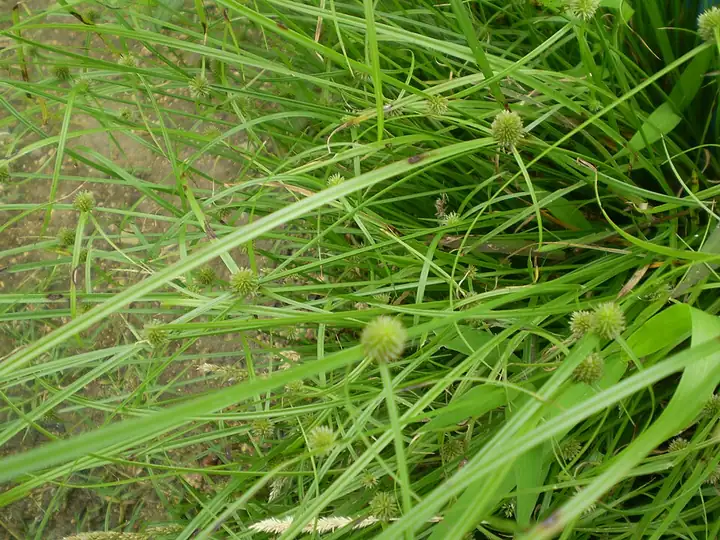
Green kyllinga
Kyllinga brevifolia
| Type | Sedge |
|---|---|
| Life cycle | Perennial |
| Family | Sedge family (Cyperaceae) |
| Origin | Introduced from elsewhere |
| Most common in | Southeast, South Central |
About
A low, mat-forming perennial sedge that thrives in wet, closely mowed lawns. It has been spreading quickly through southern lawns and is very hard to control once mats form.
Also called kyllinga, shortleaf spikesedge
How to identify it
Look for
Fine, glossy, dark green leaves (one to three per stem) with tiny barbs on the edges and triangular stems. The flower head is a small, round, green ball at the top of the stem. Reddish underground runners knit into dense mats, and there are no tubers.
Look-alikes
Yellow and purple nutsedge are taller, form tubers, and have spiky, branched flower clusters instead of one round head.
Where it grows
Moist to wet lawns in full sun, low spots, poorly drained areas and irrigated beds.
When
Grows from late spring until frost and flowers from about May through October; it stays green in mild winters but turns brown in colder areas.
How it spreads
Spreads by seed and by underground runners, and any runner piece with a joint can start a new plant.
Most common in
| Northeast | Occasional here |
|---|---|
| Southeast | Very common here |
| South Central | Very common here |
| Midwest | Occasional here |
| Great Plains | Not found here |
| Mountain West | Not found here |
| Southwest | Occasional here |
| Pacific Northwest | Occasional here |
| California | Common here |
| Alaska | Not found here |
| Hawaii | Common here |
What to do, gentlest first
Start at the top. Weed killers are a last step; always read and follow the label.
Dry out wet spots and mow a bit higher Prevent
Fix poor drainage and cut back irrigation where it keeps soil wet. Kyllinga thrives when lawns are mowed an inch or lower.
Dig out small mats completely By hand
Dig small patches while soil is moist, taking every runner. Leftover pieces regrow.
Halosulfuron, sulfentrazone or imazaquin Conventional spray
In lawns, spray halosulfuron or sulfentrazone, or imazaquin in warm-season grass, on actively growing plants, and plan on repeat applications.
Read and follow the label. Many lawn herbicides kill garden plants, so keep spray and drift off beds and vegetables.
Uses, wildlife and pets
Pets
Not listed as toxic to dogs, cats or horses by the ASPCA.
Sources
- ipm.ucanr.edu
- content.ces.ncsu.edu
- aggieturf.tamu.edu
- aggieturf.tamu.edu
- ipm.ucanr.edu
- plantsservices.sc.egov.usda.gov
- aspca.org
- aspca.org
- aspca.org
Photo: Photo: Show_ryu / Wikimedia Commons, Public domain. Photo resized for the web.

Planting dates and advice are general guidance; check with your local Cooperative Extension office for your area.