
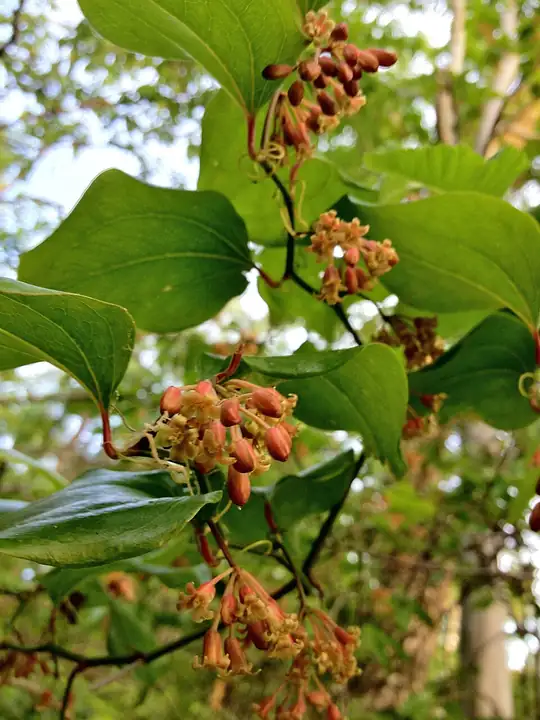
Greenbrier
Smilax rotundifolia
| Type | Vine |
|---|---|
| Life cycle | Perennial |
| Family | Greenbrier family (Smilacaceae) |
| Origin | Native to the US |
| Most common in | Northeast, Southeast |
About
A native, thorny woody vine (several Smilax species share the name) that climbs up through shrubs and hedges and scratches whoever reaches in. It's only weedy in gardens, where its deep tubers and rhizomes let it regrow after you pull the tops.
Also called common greenbrier, roundleaf greenbrier, catbrier, bullbrier, horsebrier
How to identify it
Look for
Green stems are often four-angled and armed with stiff, black-tipped prickles, and the vine climbs with tendrils. Leaves are glossy, rounded to heart-shaped, 2 to 5 inches long, with 3 to 5 main veins running lengthwise. Clusters of blue-black berries with a whitish bloom ripen in fall and hang on into winter; underground are tubers and rhizomes.
Where it grows
Inside shrubs and hedges, fence lines, woodland edges and shady beds; it tolerates low light.
When
Greenish flowers in spring and summer, with berries in fall and winter.
How it spreads
Birds spread the seeds, and the plant spreads underground by rhizomes and tubers; seedlings spend 2 to 3 years building tubers before they show much.
Most common in
| Northeast | Very common here |
|---|---|
| Southeast | Very common here |
| South Central | Common here |
| Midwest | Common here |
| Great Plains | Occasional here |
| Mountain West | Not found here |
| Southwest | Not found here |
| Pacific Northwest | Not found here |
| California | Not found here |
| Alaska | Not found here |
| Hawaii | Not found here |
What to do, gentlest first
Start at the top. Weed killers are a last step; always read and follow the label.
Pull seedlings before tubers form Prevent
Young plants take a few years to build tubers, so pull seedlings as soon as you spot them in shrubs.
Dig out the tubers By hand
Dig out the plant and as much of the tuber and rhizome system as you can. Persistence is the key; leftover tubers resprout.
Wear heavy gloves for the prickles.
Cut-and-paint or treat regrowth Conventional spray
Cut the vine at ground level and immediately paint the stub with concentrated glyphosate. Or unwind vines from shrubs, lay them on plastic and sponge on a 10% glyphosate solution, or spray regrowth when it's 6 to 8 inches tall. Triclopyr also works.
Read and follow the label. Many lawn and brush killers also harm garden plants, so keep spray and drift off anything you want to keep. The glossy leaves shed spray, so expect repeat treatments. Wait 48 hours before cutting treated vines.
Uses, wildlife and pets
Edible?
NC State Extension notes young shoots can be cooked like asparagus and young leaves like spinach. Be sure of the plant and don't eat from sprayed areas.
Not 100% sure? Don't eat it. Never pick from ground that may have been sprayed, or along roads and railways.
For wildlife
Birds such as cardinals eat the berries, deer and rabbits browse it, and thickets give cover.
Pets
Not listed as toxic by the ASPCA
Sources
Photo: Photo: Fritzflohrreynolds / Wikimedia Commons, CC BY-SA 3.0 (CC BY-SA 3.0). Photo resized for the web.

Planting dates and advice are general guidance; check with your local Cooperative Extension office for your area.