
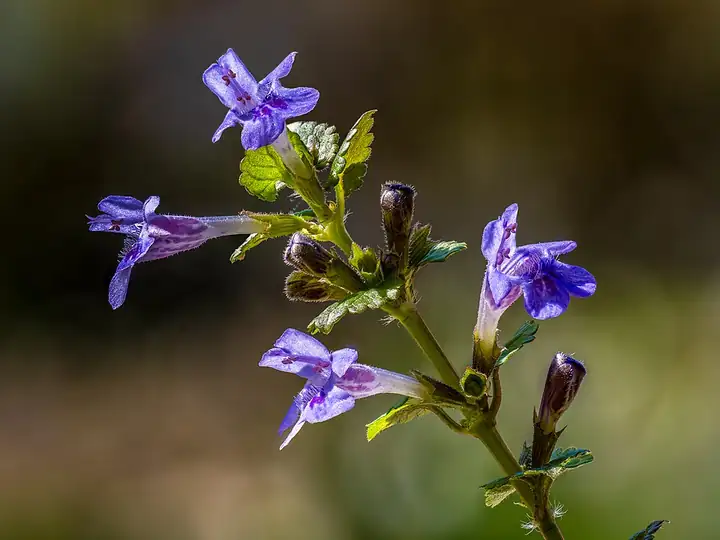
Ground Ivy
Glechoma hederacea
| Type | Broadleaf |
|---|---|
| Life cycle | Perennial |
| Family | Mint family (Lamiaceae) |
| Origin | Introduced from elsewhere |
| Most common in | Northeast, Midwest |
About
Ground ivy, or creeping Charlie, is a low mint-family plant that runs across lawns and beds on rooting stems. It forms dense mats, especially in shade, and is one of the hardest lawn weeds to clear out.
Also called creeping Charlie, gill-over-the-ground, field balm, alehoof
How to identify it
Look for
Stems are square and creep along the ground, rooting at the leaf joints. Leaves sit in pairs and are round to kidney-shaped with scalloped edges, and they smell minty or rank when crushed or mowed. Small blue-violet, funnel-shaped flowers appear in the leaf joints in spring.
Look-alikes
Henbit and purple deadnettle also have square stems but grow upright and don't root along the stems; common mallow has round stems and alternate leaves.
Where it grows
Moist, shady lawns and bed edges, especially with poor drainage or compacted, low-fertility soil, though it also grows in sun.
When
Evergreen; it blooms from early spring into early summer and spreads all growing season.
How it spreads
Mostly by long above-ground runners that root at each node, and less often by seed.
Most common in
| Northeast | Very common here |
|---|---|
| Southeast | Common here |
| South Central | Occasional here |
| Midwest | Very common here |
| Great Plains | Common here |
| Mountain West | Occasional here |
| Southwest | Occasional here |
| Pacific Northwest | Common here |
| California | Occasional here |
| Alaska | Occasional here |
| Hawaii | Not found here |
What to do, gentlest first
Start at the top. Weed killers are a last step; always read and follow the label.
Fix shade, drainage and thin turf Prevent
Improve drainage, aerate compacted soil, water less often and keep turf dense.
Rake up and pull the runners By hand
On small patches, pull runners and dig roots when the soil is moist; a stiff metal rake helps lift them. Repeat, since any piece left can regrow.
Smother patches in beds Barrier
In beds, spread a thick layer of mulch after pulling to help block regrowth.
Skip borax Organic spray
Iowa State does not recommend borax: results were inconsistent and the boron can build up and harm other plants. Vinegar only burns the tops.
Strong vinegar (over about 11% acetic acid) can burn skin and eyes, so wear gloves and eye protection. It browns any leaves it touches, grass included.
Triclopyr in fall Conventional spray
Lawn products containing triclopyr work best; 2,4-D alone does poorly. Spray actively growing plants in fall (spring works too), and expect to repeat.
Read and follow the label. Many lawn weed killers also harm vegetables, flowers and shrubs, so don't let spray drift into beds, and keep dicamba products off the root zones of trees and shrubs.
Uses, wildlife and pets
Edible?
NC State says the leaves are edible, used in tea and cooked dishes. Only pick from unsprayed ground, and be sure it isn't henbit or another square-stemmed look-alike.
Not 100% sure? Don't eat it. Never pick from ground that may have been sprayed, or along roads and railways.
For wildlife
It gives long-tongued bees nectar in April and May, when few other flowers are open.
Pets
Not listed by the ASPCA (its 'creeping Charlie' entry is a different plant, Pilea nummulariifolia). NC State lists ground ivy as toxic to horses.
Sources
- turffiles.ncsu.edu
- extension.umd.edu
- extension.umn.edu
- plants.ces.ncsu.edu
- yardandgarden.extension.iastate.edu
- extension.umd.edu
- npgsweb.ars-grin.gov
- plantsservices.sc.egov.usda.gov
- aspca.org
Photo: Photo: Reinhold Möller (Ermell) / Wikimedia Commons, CC BY-SA 4.0 (CC BY-SA 4.0). Photo resized for the web.

Planting dates and advice are general guidance; check with your local Cooperative Extension office for your area.