
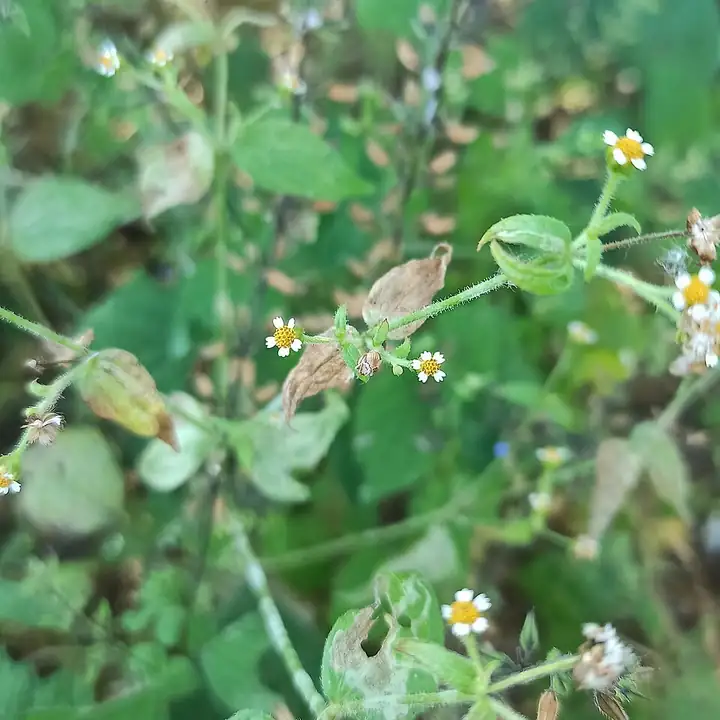
Hairy galinsoga
Galinsoga quadriradiata
| Type | Broadleaf |
|---|---|
| Life cycle | Summer annual |
| Family | Aster family (Asteraceae) |
| Origin | Introduced from elsewhere |
| Most common in | Northeast |
About
Hairy galinsoga is a low, bushy annual from Mexico and Central America that is a top weed of vegetable gardens in the Northeast and upper Midwest. It flowers within weeks of sprouting and can run through three or four generations in one summer.
Also called shaggy soldier, quickweed, galinsoga
How to identify it
Look for
Opposite, triangular to egg-shaped leaves have toothed edges, and the stems are very hairy. Tiny daisy flowers, about 1/4 inch across, have five small white (sometimes pinkish) ray petals with 3 teeth at the tip, spaced apart around a yellow center.
Look-alikes
Smallflower (smooth) galinsoga looks almost the same but has smooth or only lightly hairy stems.
Where it grows
Cultivated soil in vegetable gardens, flower beds and vegetable farms.
When
Sprouts from spring through summer and can flower 24 to 60 days after sprouting, so spring plants drop seed by early summer and more generations follow.
How it spreads
Seed (a medium plant averages around 40,000), plus broken stems that re-root in moist soil; few seeds live more than three years.
Most common in
| Northeast | Very common here |
|---|---|
| Southeast | Common here |
| South Central | Occasional here |
| Midwest | Common here |
| Great Plains | Occasional here |
| Mountain West | Occasional here |
| Southwest | Occasional here |
| Pacific Northwest | Common here |
| California | Occasional here |
| Alaska | Not found here |
| Hawaii | Occasional here |
What to do, gentlest first
Start at the top. Weed killers are a last step; always read and follow the label.
Weed every few weeks all summer Prevent
Because it flowers so fast, hoe or cultivate every 3 to 4 weeks through the season so no generation gets to seed.
Pull the whole plant and take it out By hand
Pull seedlings while tiny. Older plants tend to snap off at the base and regrow, so pull slowly or dig them.
Pulled plants and stem pieces can re-root on moist soil; carry them out of the bed.
Keep seeds in the dark Barrier
Seeds sprout mostly at the surface and hardly at all from 0.4 inch deep, so mulch that blocks light, or shallow cultivation that doesn't bring up new seed, helps a lot.
Burn down seedlings with a contact spray Organic spray
Horticultural vinegar (acetic acid), fatty-acid soap, pelargonic acid or clove-oil sprays burn what they touch within hours. They work best on young seedlings in warm, sunny weather, and you will need to repeat, because they don't move into roots and bigger plants regrow.
They kill any plant they touch, so shield crops. Strong vinegar can burn skin and eyes; wear goggles and gloves and follow the label.
Garden-labeled pre-emergent or spot spray Conventional spray
Pre-emergents labeled for your bed, or a glyphosate spot spray on the weed only.
Read and follow the label. Many lawn weed killers also kill or damage vegetables and flowers, so keep spray and drift off garden plants.
Uses, wildlife and pets
Pets
Not listed by the ASPCA.
Sources
Photo: Photo: Juan Carlos Fonseca Mata / Wikimedia Commons, CC BY-SA 4.0 (CC BY-SA 4.0). Photo resized for the web.

Planting dates and advice are general guidance; check with your local Cooperative Extension office for your area.