
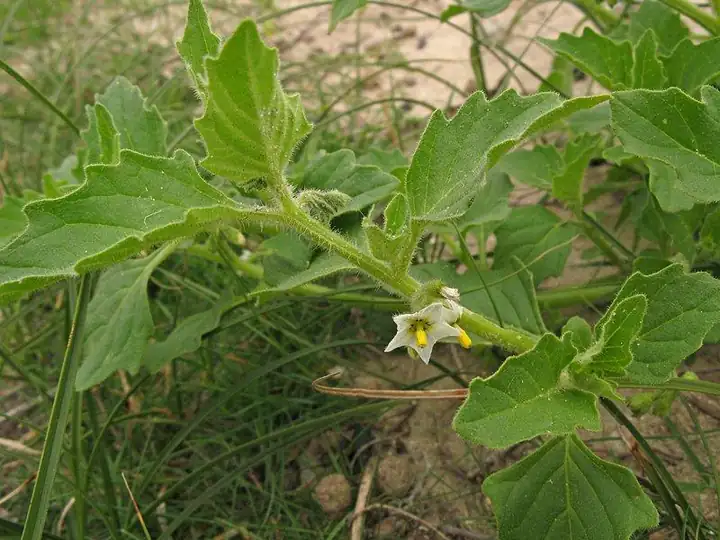
Hairy nightshade
Solanum physalifolium
| Type | Broadleaf |
|---|---|
| Life cycle | Summer annual |
| Family | Nightshade family (Solanaceae) |
| Origin | Introduced from elsewhere |
| Most common in | Great Plains, Mountain West, Pacific Northwest |
About
A low, spreading South American nightshade covered in fine, often sticky hairs, with white flowers and greenish berries that never turn black. It is one of the most troublesome nightshades in vegetable plantings, its foliage and unripe berries are poisonous, and it hosts potato and tomato pests.
Also called hoe nightshade
How to identify it
Look for
Slender stems 1-2 feet long, often sprawling, with sticky, spreading hairs. Leaves are egg-shaped with smooth to wavy or shallowly toothed edges and fine hairs, especially under the main veins. Small white star flowers (a few per cluster) become berries that ripen yellow-green to purplish-green or brownish, partly cupped by the green calyx.
Look-alikes
Eastern black nightshade and black nightshade have nearly hairless stems and ripe berries that are black, not cupped by the calyx. Treat every wild nightshade berry as unsafe to eat.
Where it grows
Vegetable and field crops, orchards, vineyards, gardens, pastures and roadsides; it handles drier conditions than the black nightshades.
When
Sprouts from mid-spring through summer in warm soil and blooms from about May to October.
How it spreads
By seed; plants average about 16,000 seeds, and some seeds last at least 5 years in the soil.
Most common in
| Northeast | Occasional here |
|---|---|
| Southeast | Occasional here |
| South Central | Occasional here |
| Midwest | Common here |
| Great Plains | Very common here |
| Mountain West | Very common here |
| Southwest | Occasional here |
| Pacific Northwest | Very common here |
| California | Common here |
| Alaska | Occasional here |
| Hawaii | Not found here |
What to do, gentlest first
Protect yourself first. Weed killers are a last step; always read and follow the label.
Keep it out of tomato and potato beds Prevent
Rogue out every plant from beds used for tomatoes, potatoes and peppers, including rest years in your rotation, and avoid extra nitrogen and phosphorus, which it loves.
Hoe or pull before berries By hand
Normal hoeing and cultivation keep light infestations in check. Pull plants before berries form; plants cut back hard resprout.
Wear gloves; bag plants with berries.
Solarize Barrier
Solarizing moist soil so the top layer reaches about 122-131°F for two days stops seeds near the surface from sprouting.
Spot-treat when needed Conventional spray
In landscape beds, glyphosate as a spot treatment; in lawns, 2,4-D products.
Read and follow the label. Many lawn weed killers also kill vegetables and flowers, and glyphosate harms any plant it touches.
Uses, wildlife and pets
Pets
Nightshades (Solanum species) are listed by the ASPCA as toxic to dogs, cats and horses; signs include drooling, severe stomach upset, diarrhea, drowsiness, weakness, dilated pupils and a slow heart rate. Nightshade mixed into hay or forage stays poisonous to livestock.
Sources
- ipm.ucanr.edu
- cals.cornell.edu
- ipm.ucanr.edu
- hortsense.cahnrs.wsu.edu
- plantsservices.sc.egov.usda.gov
- aspca.org
- poison.org
- poison.org
Photo: Photo: Quentin Groom / Wikimedia Commons, CC BY-SA 3.0 (CC BY-SA 3.0). Photo resized for the web.

Planting dates and advice are general guidance; check with your local Cooperative Extension office for your area.