
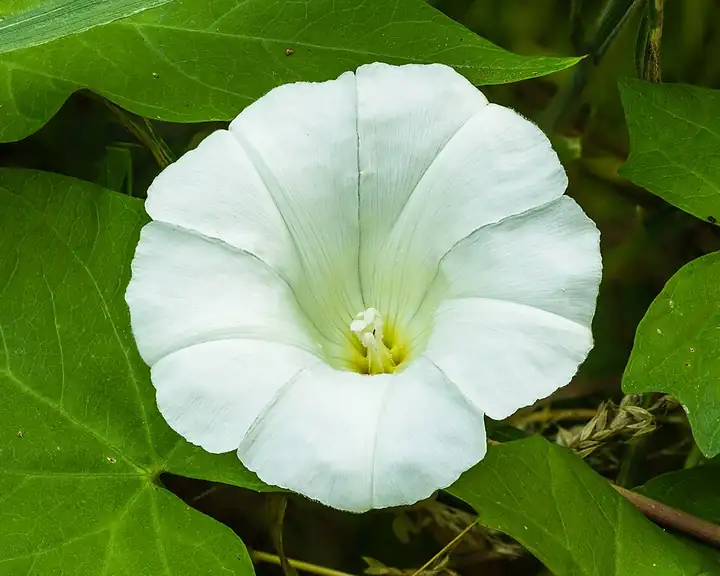
Hedge bindweed
Calystegia sepium
| Type | Vine |
|---|---|
| Life cycle | Perennial |
| Family | Morning glory family (Convolvulaceae) |
| Origin | Native and introduced forms |
| Most common in | Northeast, Midwest |
About
Hedge bindweed is a big twining vine with white to pink trumpet flowers that climbs over shrubs, fences and perennials. It spreads by fleshy rhizomes and is hard to get rid of once it is woven through a bed.
Also called hedge false bindweed, large bindweed, great bindweed, bellbind, wild morning glory
How to identify it
Look for
Leaves are triangular to heart-shaped, 2 to 5 inches long, with squared-off lobes at the base. Flowers are white or pink funnels 1.5 to 3 inches long, each with two large green leafy bracts wrapped around the base. Stems twine up anything nearby.
Look-alikes
Field bindweed is smaller in every way: arrowhead leaves up to about 2 inches, flowers about 1 inch, and no large bracts hiding the base of the flower.
Where it grows
Fence rows, hedges, ornamental beds, gardens, field edges and damp waste areas in sun.
When
Shoots appear in spring and it flowers from late spring until frost.
How it spreads
Spreads by fleshy white rhizomes that regrow from any piece left in the soil, and by seeds (2 to 4 per pod) carried by water and birds.
Most common in
| Northeast | Very common here |
|---|---|
| Southeast | Common here |
| South Central | Common here |
| Midwest | Very common here |
| Great Plains | Common here |
| Mountain West | Occasional here |
| Southwest | Occasional here |
| Pacific Northwest | Common here |
| California | Occasional here |
| Alaska | Occasional here |
| Hawaii | Not found here |
What to do, gentlest first
Start at the top. Weed killers are a last step; always read and follow the label.
Watch fence lines and hedges Prevent
Keep an eye on fences and hedges bordering the garden, and pull new shoots while they are small. Don't bring in soil or divisions with white rhizome pieces in them.
Pull and dig rhizomes By hand
Unwind vines and dig out as much rhizome as you can; most roots are in the top 2 feet. Keep pulling regrowth all season to wear the rhizomes down.
Any rhizome piece left behind can sprout.
Smother bare areas Barrier
In empty beds, cover the patch with black plastic or heavy landscape fabric with overlapped edges to block light for a season or more.
Spot-treat untangled vines Conventional spray
Pull vines off good plants, lay them on plastic or train them onto a stake, then treat the leaves with glyphosate or triclopyr; in lawns, 2,4-D or triclopyr products can be used.
Read and follow the label; many lawn and brush herbicides also kill garden plants. These are not selective and will harm any plant they touch.
Uses, wildlife and pets
For wildlife
The flowers draw pollinators, and the vine is a larval host and cover for wildlife.
Pets
Not listed by the ASPCA.
Sources
- hortsense.cahnrs.wsu.edu
- extension.psu.edu
- plants.ces.ncsu.edu
- plantsservices.sc.egov.usda.gov
- aspca.org
Photo: Photo: Dominicus Johannes Bergsma / Wikimedia Commons, CC BY-SA 4.0 (CC BY-SA 4.0). Photo resized for the web.

Planting dates and advice are general guidance; check with your local Cooperative Extension office for your area.