
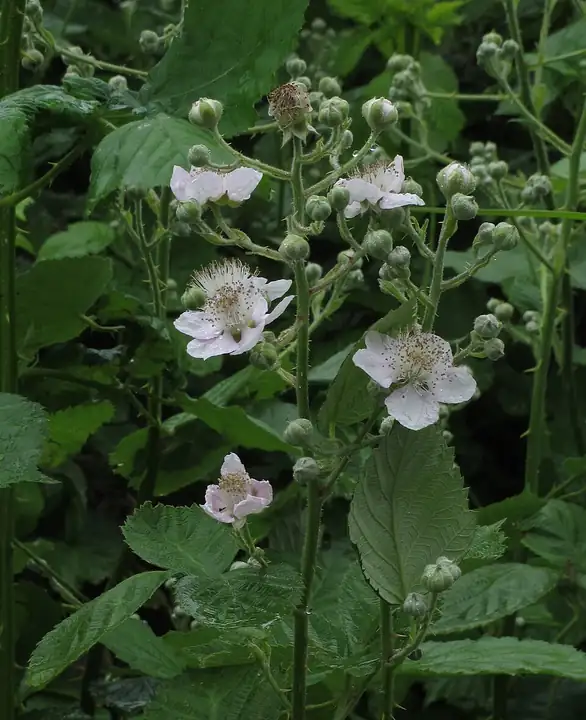
Himalayan blackberry
Rubus armeniacus
| Type | Shrub or tree |
|---|---|
| Life cycle | Perennial |
| Family | Rose family (Rosaceae) |
| Origin | Introduced from elsewhere |
| Most common in | Pacific Northwest, California |
About
A huge, thorny, nearly evergreen blackberry from Eurasia that forms impenetrable thickets along the West Coast. It crowds out other plants, blocks paths and streams, shelters rats, and its dead canes are a fire hazard.
Also called Armenian blackberry, European blackberry, Himalaya berry
How to identify it
Look for
Stout, 5-angled canes grow 20 to 40 feet long and are armed with large, hooked prickles. Leaves usually have 5 toothed, oval leaflets (3 on some shoots). White to pink flowers about an inch across come in flat-topped clusters, followed by large shiny black berries.
Look-alikes
Native California blackberry has 3 leaflets, and cutleaf blackberry has 5 deeply cut leaflets. Poison oak has no thorns and whitish berries.
Where it grows
Roadsides, fence lines, stream banks, field edges, logged land, vacant lots and neglected yards.
When
Flowers from about June to August, and berries ripen in late summer; each cane lives 2 years, fruiting in its second year.
How it spreads
Animals spread the long-lived seeds, cane tips root where they touch the ground, and root crowns and root pieces resprout.
Most common in
| Northeast | Occasional here |
|---|---|
| Southeast | Occasional here |
| South Central | Occasional here |
| Midwest | Occasional here |
| Great Plains | Occasional here |
| Mountain West | Occasional here |
| Southwest | Occasional here |
| Pacific Northwest | Very common here |
| California | Very common here |
| Alaska | Occasional here |
| Hawaii | Not found here |
Where it is regulated
Washington lists it as a Class C noxious weed.
What to do, gentlest first
Start at the top. Weed killers are a last step; always read and follow the label.
Catch cane tips before they root Prevent
Cut back arching canes before their tips touch the soil and root, and pull seedlings while small.
Cut canes, then dig the root crowns By hand
Cut the canes back first, then dig out the root crowns and main roots. Dig in early spring or late fall when the soil is moist; pulling in dry, hard soil snaps stems and leaves roots that resprout.
Wear heavy gloves and long sleeves for the thorns.
Goats or sheep Natural enemies
Steady grazing by goats (and sometimes sheep) can keep small areas suppressed if they keep eating the resprouts.
Triclopyr or glyphosate after flowering Conventional spray
Spray leaves in late summer or early fall after flowering, or treat fresh cut stumps in spring or fall. Retreat resprouts once they're about 2 feet tall with fully open leaves.
Read and follow the label. Many lawn and brush killers also harm garden plants, so keep spray and drift off anything you want to keep.
Uses, wildlife and pets
Edible?
The ripe berries are edible and tasty, and many people pick them in late summer (UC IPM). Don't pick from roadsides or anywhere that may have been sprayed.
Not 100% sure? Don't eat it. Never pick from ground that may have been sprayed, or along roads and railways.
For wildlife
Many birds, mammals and insects use it for food and cover, and bumblebees and honey bees pollinate the flowers.
Pets
Not listed as toxic by the ASPCA
Sources
Photo: Photo: Robert Flogaus-Faust / Wikimedia Commons, CC BY 4.0 (CC BY 4.0). Photo resized for the web.

Planting dates and advice are general guidance; check with your local Cooperative Extension office for your area.