
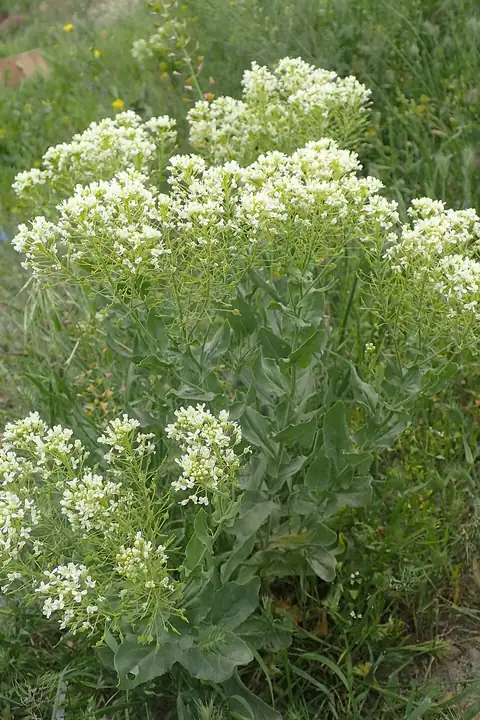
Hoary cress
Lepidium draba
| Type | Broadleaf |
|---|---|
| Life cycle | Perennial |
| Family | Mustard family (Brassicaceae) |
| Origin | Introduced from elsewhere |
| Most common in | Mountain West, Pacific Northwest |
About
Hoary cress, or whitetop, is a creeping perennial mustard from Europe and Asia that blankets western yards, ditches and pastures with flat-topped white flowers in spring. Its roots run many feet deep and sideways, so pulling it only works if you keep at it for years.
Also called whitetop, white top
How to identify it
Look for
Stems stand up to 2 feet tall with blue-green, lance-shaped leaves; the upper leaves have two lobes that clasp the stem. In spring it has many flat-topped clusters of tiny white, four-petaled flowers. Seed pods are small, puffy and heart-shaped.
Look-alikes
Hairy whitetop and lens-podded whitetop are close relatives that look very similar and are handled together by weed programs.
Where it grows
Disturbed ground, yards, pastures, roadsides, ditch and river banks, and salty soils, mostly in the West.
When
It comes up early in spring, flowers from about April to July, and may make fall rosettes after rain.
How it spreads
Mostly by creeping roots that can reach several feet deep and spread up to 30 feet in three years; root pieces as short as 2 inches regrow, and a plant makes 1,200 to 4,800 seeds.
Most common in
| Northeast | Occasional here |
|---|---|
| Southeast | Not found here |
| South Central | Occasional here |
| Midwest | Occasional here |
| Great Plains | Common here |
| Mountain West | Very common here |
| Southwest | Common here |
| Pacific Northwest | Very common here |
| California | Common here |
| Alaska | Not found here |
| Hawaii | Not found here |
Where it is regulated
Listed as a noxious weed in Washington (Class C) and Nevada.
What to do, gentlest first
Start at the top. Weed killers are a last step; always read and follow the label.
Remove it before it flowers, every time By hand
Pull, hoe or shallowly cultivate plants before flowering and keep repeating whenever they regrow; it takes several years.
Root pieces left in the soil regrow, so don't till it in. Don't compost it; put it in the trash.
Smother or solarize for a season Barrier
USU suggests cutting plants to the ground in spring, covering with overlapping cardboard and 3 to 4 inches of mulch for a year. Solarizing under clear plastic also helps.
Sheep or goats on larger land Natural enemies
Sheep or goats graze it better than cattle, best from late leafy growth to early bolting.
Systemic herbicide in spring and fall Conventional spray
USU lists 2,4-D (lawns) and glyphosate (beds and bare ground), sprayed in spring before flower buds open and again in early fall. Metsulfuron works best but is mostly for professionals.
Read and follow the label. Many lawn weed killers also kill garden plants, so keep spray and drift off beds and vegetables. Many lawn products shouldn't be used above 85 F.
Uses, wildlife and pets
Pets
Not listed by the ASPCA. It contains glucosinolates that can be toxic to cattle in large amounts (University of Nevada Extension).
Sources
Photo: Photo: Krzysztof Ziarnek, Kenraiz / Wikimedia Commons, CC BY-SA 4.0 (CC BY-SA 4.0). Photo resized for the web.

Planting dates and advice are general guidance; check with your local Cooperative Extension office for your area.