
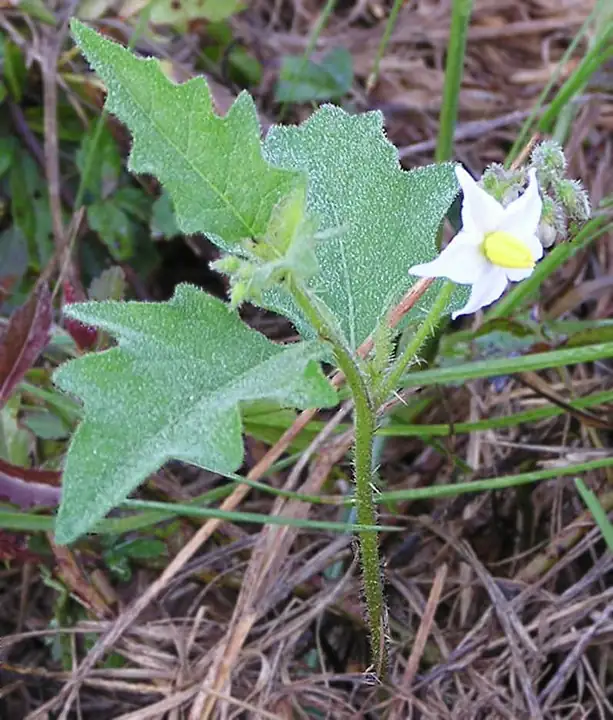
Horsenettle
Solanum carolinense
| Type | Broadleaf |
|---|---|
| Life cycle | Perennial |
| Family | Nightshade family (Solanaceae) |
| Origin | Native to the US |
| Most common in | Northeast, Southeast, South Central, Midwest |
About
A prickly native perennial nightshade that spreads by deep, creeping roots and is very hard to get rid of once it settles in. Its leaves and yellow, tomato-like berries are poisonous to people, pets and livestock, and its spines hurt.
Also called Carolina horsenettle, horse nettle, bull nettle, devil's tomato, apple of Sodom
How to identify it
Look for
Upright, zigzag stems 1-3 feet tall carry sharp yellowish or white spines, and the leaf veins are prickly too. Leaves are alternate, 2-6 inches, with wavy or shallowly lobed edges and star-shaped hairs. White to light violet star-shaped flowers with yellow centers are followed by smooth green berries that turn yellow and wrinkle, like tiny tomatoes.
Look-alikes
Buffalobur is also spiny but has yellow flowers, deeply lobed leaves and berries wrapped in a spiny husk; clammy groundcherry has densely hairy stems and berries inside a papery husk. Tropical soda apple (Solanum viarum) is often confused with it.
Where it grows
Pastures, hay fields, gardens, crop fields, lawns and roadsides; it does best in sandy or coarse soil but tolerates most soils and some shade.
When
Seedlings appear from mid-May, and new shoots rise from the roots from mid-spring through summer; it blooms about 5-8 weeks after emerging, into fall, and berries ripen in fall and winter.
How it spreads
By seed (up to about 5,000 per shoot) and by deep creeping roots; root pieces as short as about 1/2 inch can grow new plants.
Most common in
| Northeast | Very common here |
|---|---|
| Southeast | Very common here |
| South Central | Very common here |
| Midwest | Very common here |
| Great Plains | Common here |
| Mountain West | Occasional here |
| Southwest | Occasional here |
| Pacific Northwest | Occasional here |
| California | Occasional here |
| Alaska | Not found here |
| Hawaii | Not found here |
Where it is regulated
It is a noxious weed seed under state seed laws in many states, including Colorado, Hawaii and Idaho (prohibited) and Alabama, Arkansas, Delaware, Florida, Georgia, Illinois, Indiana and Kansas (restricted).
What to do, gentlest first
Protect yourself first. Weed killers are a last step; always read and follow the label.
Don't chop up the roots Prevent
Tilling a patch once just spreads root pieces that sprout new plants. If you do cultivate, keep at it repeatedly through summer.
Cut or dig shoots again and again By hand
Remove shoots over and over, especially 1-2 months after they emerge, when the roots' food reserves are lowest. A single mowing only sets it back for about a month.
Wear thick gloves; the spines are sharp.
Spot-treat persistent patches Conventional spray
In landscape beds, glyphosate as a spot treatment; in lawns, 2,4-D products. Expect to repeat, as it resists some herbicides.
Read and follow the label. Many lawn weed killers also kill vegetables and flowers, and glyphosate harms any plant it touches.
Uses, wildlife and pets
For wildlife
Bumblebees pollinate the flowers, and quail and wild turkeys eat the ripe berries.
Pets
Nightshades (Solanum species) are listed by the ASPCA as toxic to dogs, cats and horses; signs include drooling, severe stomach upset, diarrhea, drowsiness, weakness, dilated pupils and a slow heart rate. Cattle, horses, sheep, goats and pigs can be poisoned too, mostly in late summer when berries are green.
Sources
- cals.cornell.edu
- plants.ces.ncsu.edu
- ag.purdue.edu
- hortsense.cahnrs.wsu.edu
- plantsservices.sc.egov.usda.gov
- aspca.org
- poison.org
- poison.org
- ams.usda.gov
Photo: Photo: Richardelainechambers / Wikimedia Commons, CC BY-SA 3.0 (CC BY-SA 3.0). Photo resized for the web.

Planting dates and advice are general guidance; check with your local Cooperative Extension office for your area.