
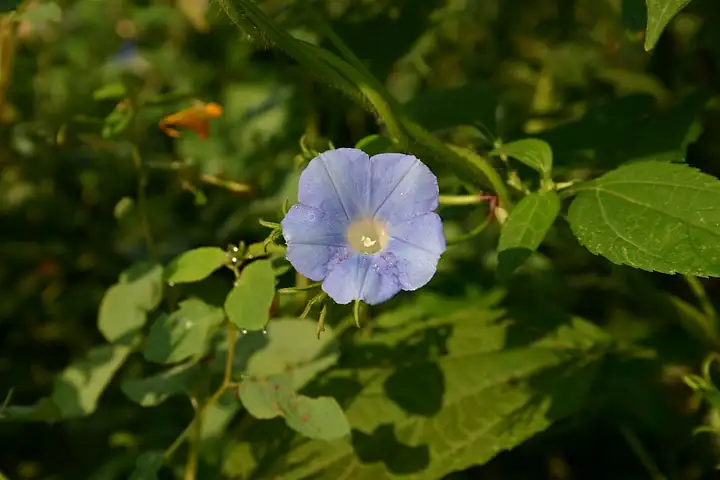
Ivyleaf morningglory
Ipomoea hederacea
| Type | Vine |
|---|---|
| Life cycle | Summer annual |
| Family | Morning glory family (Convolvulaceae) |
| Origin | Introduced from elsewhere |
| Most common in | Southeast, South Central, Midwest |
About
A fast, twining summer vine with three-lobed, ivy-like leaves and pale blue to purple trumpet flowers. It climbs over and smothers garden crops and fences, and its hard-coated seeds can wait in the soil for well over a decade.
Also called ivyleaf morning-glory, ivy-leaved morning glory, entireleaf morningglory
How to identify it
Look for
Seedlings have butterfly-shaped seed leaves; the first true leaf is heart-shaped and later leaves have three deep lobes. Stems, leaf stalks and leaves are covered in hairs that stand straight out. Funnel flowers 1-2 inches long open white to pale blue and fade to pink-purple, and round capsules hold 4-6 dark, wedge-shaped seeds.
Look-alikes
Tall morningglory has heart-shaped leaves with hairs lying flat. A form of this same species (entireleaf morningglory) has unlobed, heart-shaped leaves.
Where it grows
Vegetable gardens, crop fields, fence rows and field edges; it likes rich, moist soil but adapts to most sites.
When
Comes up late in spring and keeps sprouting through summer, peaking in early summer; it starts blooming 4-7 weeks after emergence (roughly July-September) and sets seed until frost kills it.
How it spreads
By seed; a plant can make about 11,000 seeds with no competition, hard seeds have lived up to 17 years in soil, and seedlings can come up from 4 inches deep.
Most common in
| Northeast | Common here |
|---|---|
| Southeast | Very common here |
| South Central | Very common here |
| Midwest | Very common here |
| Great Plains | Common here |
| Mountain West | Occasional here |
| Southwest | Occasional here |
| Pacific Northwest | Occasional here |
| California | Occasional here |
| Alaska | Not found here |
| Hawaii | Not found here |
Where it is regulated
Morningglory seeds (Ipomoea species) are noxious weed seeds under state seed laws in states including Arizona (prohibited) and Arkansas, Hawaii and Kansas (restricted).
What to do, gentlest first
Protect yourself first. Weed killers are a last step; always read and follow the label.
Clean up fence rows and use a stale seedbed Prevent
Pull vines along fences and garden edges before they seed. Before planting, water the bed to sprout a flush of seedlings, then kill them with shallow cultivation.
Pull seedlings before 5 inches By hand
Hand-pull or hoe seedlings before they are about 5 inches long and start wrapping around your plants.
Use plastic mulch or solarize Barrier
Plastic mulch stops the seedlings, but straw and other loose mulches don't; seedlings can push through 6 inches of straw. Solarizing moist soil under clear plastic in hot weather kills many seeds near the surface.
Uses, wildlife and pets
Pets
Morning glories (Ipomoea species) are listed by the ASPCA as toxic to dogs, cats and horses; eating the seeds can cause vomiting, and large amounts may cause hallucinations.
Sources
- cals.cornell.edu
- weedid.cals.vt.edu
- vegcropshotline.org
- plantsservices.sc.egov.usda.gov
- aspca.org
- poison.org
- ams.usda.gov
Photo: Photo: SB_Johnny / Wikimedia Commons, CC BY-SA 3.0 (CC BY-SA 3.0). Photo resized for the web.

Planting dates and advice are general guidance; check with your local Cooperative Extension office for your area.