
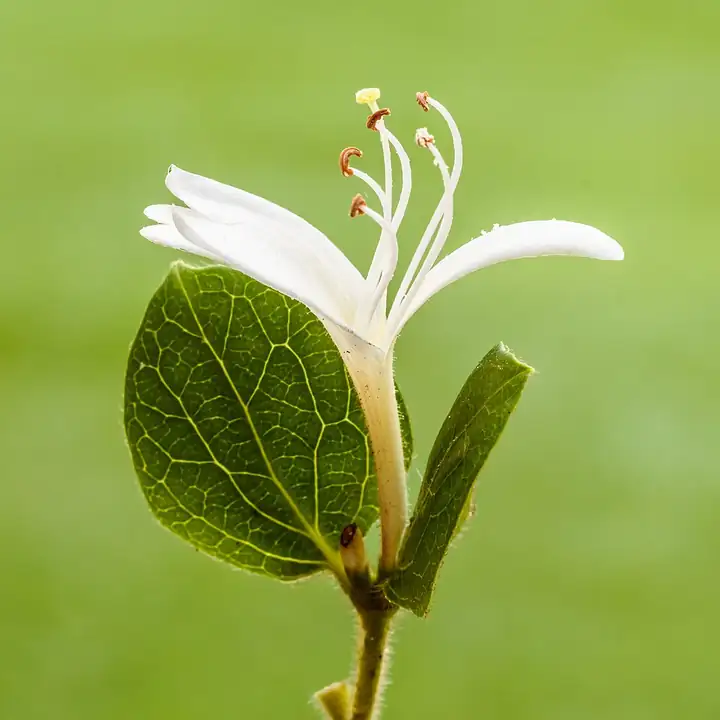
Japanese honeysuckle
Lonicera japonica
| Type | Vine |
|---|---|
| Life cycle | Perennial |
| Family | Honeysuckle family (Caprifoliaceae) |
| Origin | Introduced from elsewhere |
| Most common in | Northeast, Southeast, South Central |
About
A sweet-smelling, semi-evergreen twining vine from East Asia that sprawls over the ground and climbs shrubs and small trees. It smothers and strangles other plants and resprouts from its roots and stem joints after cutting.
Also called Hall's honeysuckle, Chinese honeysuckle, gold-and-silver honeysuckle, honeysuckle vine
How to identify it
Look for
Leaves are opposite, oval, smooth-edged and about 1 to 3 inches long; some early-season leaves are lobed. Young stems are reddish and fuzzy, and older stems are hollow with peeling bark. Fragrant, tubular white flowers come in pairs, age to yellow, and are followed by shiny black berries in fall.
Look-alikes
Native coral (trumpet) honeysuckle, Lonicera sempervirens, has red tubular flowers in clusters at the stem tips and its top pairs of leaves are fused around the stem.
Where it grows
Woodland edges, fence rows, hedges, roadsides and neglected beds; it tolerates shade and can persist under trees.
When
Flowers from spring into summer (sometimes into fall), and berries ripen from late summer through fall; it stays green most of the winter in the South.
How it spreads
Birds and rabbits spread the seeds, and runners root at the nodes where they touch soil.
Most common in
| Northeast | Very common here |
|---|---|
| Southeast | Very common here |
| South Central | Very common here |
| Midwest | Common here |
| Great Plains | Occasional here |
| Mountain West | Occasional here |
| Southwest | Occasional here |
| Pacific Northwest | Occasional here |
| California | Occasional here |
| Alaska | Not found here |
| Hawaii | Occasional here |
Where it is regulated
Illinois bans its sale under its exotic weed law.
What to do, gentlest first
Start at the top. Weed killers are a last step; always read and follow the label.
Plant native coral honeysuckle instead Prevent
If you want a honeysuckle vine, choose native coral honeysuckle. Check fence lines and hedges each year for new seedlings.
Pull vines and roots By hand
For small patches, pull and unwind the vines by hand and dig out rooted runners. Remove any berries too, and watch for resprouts.
Mowing and goat grazing tend to make it grow back thicker, so they aren't good fixes.
Glyphosate or triclopyr, best in fall Conventional spray
Spray a 2% solution on the leaves, or paint a 25% solution on freshly cut stems. Spring through fall works, but fall applications work best.
Read and follow the label. Many lawn and brush killers also harm garden plants, so keep spray and drift off anything you want to keep.
Uses, wildlife and pets
For wildlife
Hummingbirds, moths and butterflies visit the flowers, and birds eat the berries.
Pets
Not listed as toxic by the ASPCA
Sources
Photo: Photo: Dominicus Johannes Bergsma / Wikimedia Commons, CC BY-SA 4.0 (CC BY-SA 4.0). Photo resized for the web.

Planting dates and advice are general guidance; check with your local Cooperative Extension office for your area.