
Kochia
Bassia scoparia
| Type | Broadleaf |
|---|---|
| Life cycle | Summer annual |
| Family | Goosefoot family (Chenopodiaceae) |
| Origin | Introduced from elsewhere |
| Most common in | Great Plains, Mountain West |
About
Kochia is a bushy, upright summer annual that thrives on roadsides, ditch banks and newly planted fields. Its leaves hold saponins, oxalates and nitrates that can be toxic to livestock.
Also called burningbush, Mexican fireweed, mirabel, mock cypress
How to identify it
Look for
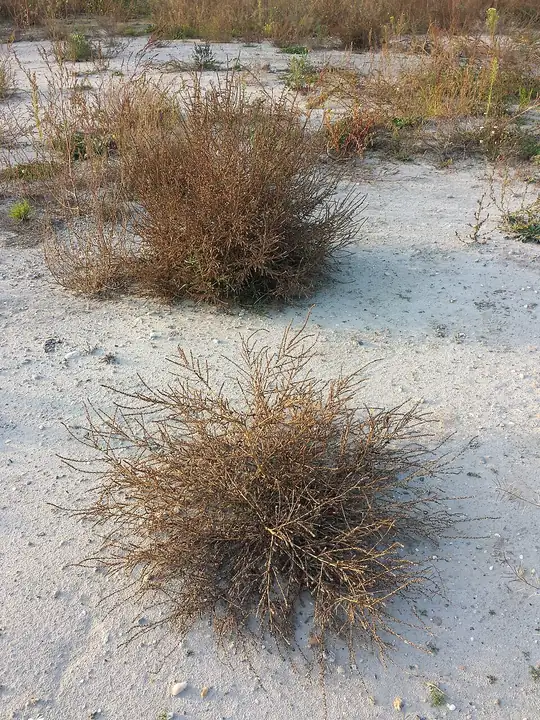
Plants grow 2 to 5 feet tall and branch from the base into a rounded bush. Leaves are narrow, flat, gray-green and alternate, from about 1/5 inch to 2 1/2 inches long. Tiny green flowers with no petals sit tight against the stems in late summer.
Look-alikes
Fivehook bassia is very hard to tell apart, but kochia branches from the base while fivehook bassia branches along the main stem.
Where it grows
Roadsides, fields, newly planted crop ground, ditch edges, seasonal wetlands and other disturbed places.
When
Grows through the warm season and flowers from July through October.
How it spreads
Seed only.
Most common in
| Northeast | Occasional here |
|---|---|
| Southeast | Occasional here |
| South Central | Common here |
| Midwest | Common here |
| Great Plains | Very common here |
| Mountain West | Very common here |
| Southwest | Common here |
| Pacific Northwest | Common here |
| California | Common here |
| Alaska | Not found here |
| Hawaii | Not found here |
What to do, gentlest first
Start at the top. Weed killers are a last step; always read and follow the label.
Stop it before it seeds Prevent
Remove plants before the late-summer flowers set seed, and keep bare, disturbed ground planted or covered.
Pull or hoe young plants By hand
Pull or hoe while plants are small and before they flower; repeat until your plantings fill in.
Mulch bare soil Barrier
Use 3 to 4 inches of medium bark or wood-chip mulch in beds, or landscape fabric with about an inch of mulch on top.
Burn down seedlings with a contact spray Organic spray
Horticultural vinegar (acetic acid), fatty-acid soap, pelargonic acid or clove-oil sprays burn what they touch within hours. They work best on small seedlings in warm, sunny weather, and you will need to repeat, because they don't move into roots and bigger plants regrow.
They kill any plant they touch, so shield crops. Strong vinegar can burn skin and eyes; wear goggles and gloves and follow the label.
Spot spray young plants Conventional spray
In beds, glyphosate as a spot spray on the weed only; in lawns, a broadleaf herbicide such as 2,4-D. Ask your extension office which products work locally.
Read and follow the label. Many lawn weed killers also kill or damage vegetables and flowers, so keep spray and drift off garden plants.
Uses, wildlife and pets
Pets
Not listed by the ASPCA under kochia. Its leaves can be toxic to livestock (UC IPM).
Sources
Photo: Photo: Stefan.lefnaer / Wikimedia Commons, CC BY-SA 4.0 (CC BY-SA 4.0). Photo resized for the web.

Planting dates and advice are general guidance; check with your local Cooperative Extension office for your area.