
Kudzu
Pueraria montana var. lobata
| Type | Vine |
|---|---|
| Life cycle | Perennial |
| Family | Pea family (Fabaceae) |
| Origin | Introduced from elsewhere |
| Most common in | Southeast |
About
A fast, climbing pea-family vine from Asia that can grow up to a foot a day and blanket trees, sheds and fences. It spreads from rooting runners and woody root crowns, and big patches take years to clear.
Also called kudzu vine
How to identify it
Look for
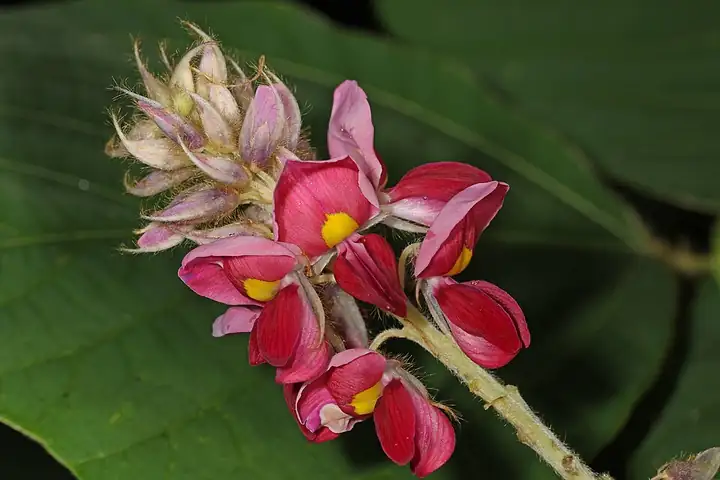
Leaves are compound with three broad leaflets up to 4 inches across, sometimes lobed in sun, and drop at the first frost. Older vines turn woody with rough brown bark, and pea-like flowers grow in 4- to 8-inch clusters on climbing vines in mid to late summer, followed by pods about 1.5 to 2 inches long. Where a vine touches the ground it roots and forms a knobby root crown at or just below the soil surface.
Where it grows
Forest edges, old fields, roadsides and neglected yard corners, especially on deep, well-drained soils where winters are mild.
When
New growth starts in spring, flowers appear from about July to September, pods ripen in fall, and the leaves die back at the first frost.
How it spreads
Mostly by runners that root every few feet and form new root crowns; seed set is poor in North America, with only 1 or 2 good seeds in a cluster of pods.
Most common in
| Northeast | Common here |
|---|---|
| Southeast | Very common here |
| South Central | Common here |
| Midwest | Occasional here |
| Great Plains | Occasional here |
| Mountain West | Not found here |
| Southwest | Not found here |
| Pacific Northwest | Occasional here |
| California | Not found here |
| Alaska | Not found here |
| Hawaii | Occasional here |
Where it is regulated
Kansas, Pennsylvania, Florida, West Virginia and Oregon list it as a noxious weed.
What to do, gentlest first
Start at the top. Weed killers are a last step; always read and follow the label.
Catch it while it's small Prevent
Young patches with few root crowns are far easier to kill than old ones. Don't let vines climb trees or spread into your yard from a neighbor's lot; talk with neighbors about treating a shared line together.
Cut out the root crowns By hand
Dig down with a shovel or pick to expose each root crown, cut just below it with a hatchet or saw, and remove it. You don't need to dig out the huge storage root, which can't sprout on its own.
Bag or otherwise destroy removed crowns and vines; don't compost them.
Cut every vine to the ground, weekly By hand
Cutting all vines to ground level about once a week (every 2 weeks at minimum) starves the roots. It can take several years, and trimming vines back now and then won't work.
Heavy grazing Natural enemies
Steady, intense grazing by livestock can wear down younger kudzu patches by draining root reserves.
Glyphosate or triclopyr, twice a season Conventional spray
Spray fully expanded leaves in late spring or early summer, then treat new growth again in late summer or fall. Cut-stump treatment works well when root crowns are exposed after mowing. Expect repeat treatments for several years.
Read and follow the label. Many lawn and brush killers also harm garden plants, so keep spray and drift off anything you want to keep. Don't spray vines draped over trees, shrubs or gardens you want to keep; pull those vines down by hand instead.
Uses, wildlife and pets
For wildlife
Livestock graze it, and bobwhite quail eat the seeds in some areas.
Pets
Not listed as toxic by the ASPCA
Sources
Photo: Photo: Judy Gallagher / Wikimedia Commons, CC BY 4.0 (CC BY 4.0). Photo resized for the web.

Planting dates and advice are general guidance; check with your local Cooperative Extension office for your area.