
Ladysthumb
Persicaria maculosa
| Type | Broadleaf |
|---|---|
| Life cycle | Summer annual |
| Family | Buckwheat family (Polygonaceae) |
| Origin | Introduced from elsewhere |
| Most common in | Northeast, Midwest, Pacific Northwest |
About
Ladysthumb is a European smartweed with a dark thumbprint on each leaf, common in moist gardens and fields across the country. It is a modest seed producer but its seeds can wait in the soil for 20 years or more.
Also called lady's thumb, spotted ladysthumb, spotted smartweed, heartweed, red shanks
How to identify it
Look for
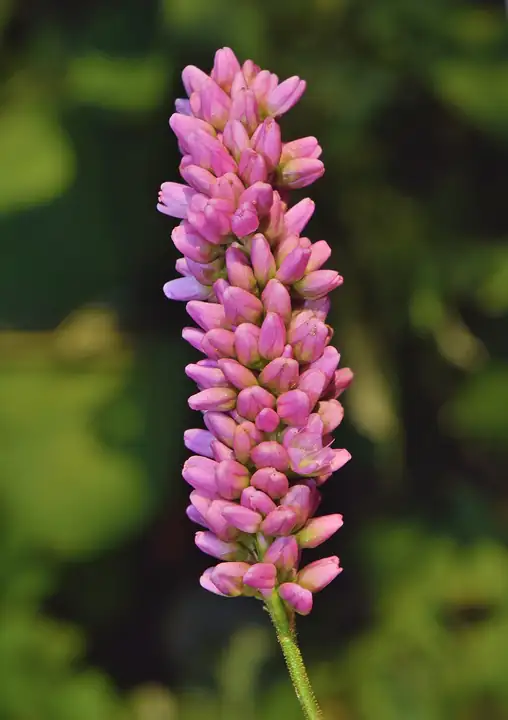
Lance-shaped leaves, 1 to 6 inches long, usually carry a dark purple blotch near the middle. Each swollen stem joint is wrapped in a papery sheath topped with a fringe of short bristles. Short, dense spikes, about an inch long, hold pink to purplish-red flowers.
Look-alikes
Pennsylvania smartweed is nearly identical but its stem sheaths have no bristles and its flower stalks are sticky-hairy; pale smartweed has no leaf blotch.
Where it grows
Moist gardens, wet field spots, ditches, pastures and areas that flood now and then; it also handles dry spells.
When
Sprouts early to mid spring, with some into early summer; it flowers 6 to 9 weeks later and seeds from July into fall.
How it spreads
Seed only: usually 200 to 800 seeds per plant, up to a few thousand on big ones; some seeds last 20 years undisturbed.
Most common in
| Northeast | Very common here |
|---|---|
| Southeast | Common here |
| South Central | Common here |
| Midwest | Very common here |
| Great Plains | Common here |
| Mountain West | Common here |
| Southwest | Occasional here |
| Pacific Northwest | Very common here |
| California | Common here |
| Alaska | Occasional here |
| Hawaii | Not found here |
What to do, gentlest first
Start at the top. Weed killers are a last step; always read and follow the label.
Clear the spring flush before planting Prevent
Nearly all seedlings are up by early summer, so cultivate just before planting warm-season crops and pull any plants before they flower.
Pull or hoe By hand
Hoe seedlings or pull young plants; seeds come mostly from the top 1.6 inches of soil.
Mulch Barrier
Organic or synthetic mulches suppress smartweeds well.
Corn gluten meal pre-emergent Organic spray
Iowa State lists smartweed among the weeds corn gluten meal can stop as they sprout. Spread it before the weed seeds germinate (about 20 pounds per 1,000 square feet) and water it in lightly; it does nothing to plants that are already up.
It also stops seeds you sow, so don't use it where you plan to plant seeds soon. Heavy rain right after spreading weakens it.
Burn down seedlings with a contact spray Organic spray
Horticultural vinegar (acetic acid), fatty-acid soap, pelargonic acid or clove-oil sprays burn what they touch within hours. They work best on young seedlings in warm, sunny weather, and you will need to repeat, because they don't move into roots and bigger plants regrow.
They kill any plant they touch, so shield crops. Strong vinegar can burn skin and eyes; wear goggles and gloves and follow the label.
Spot spray young plants Conventional spray
In beds, glyphosate as a spot spray on the weed only; in lawns, a broadleaf herbicide such as 2,4-D.
Read and follow the label. Many lawn weed killers also kill or damage vegetables and flowers, so keep spray and drift off garden plants.
Uses, wildlife and pets
For wildlife
Birds and cottontail rabbits eat the seeds (SARE).
Pets
Not listed by the ASPCA.
Sources
- sare.org
- ipm.ucanr.edu
- crops.extension.iastate.edu
- plantsservices.sc.egov.usda.gov
- yardandgarden.extension.iastate.edu
- ipm.ucanr.edu
- ucanr.edu
Photo: Photo: The Cosmonaut / Wikimedia Commons, CC BY-SA 2.5 ca (CC BY-SA 2.5 ca). Photo resized for the web.

Planting dates and advice are general guidance; check with your local Cooperative Extension office for your area.