
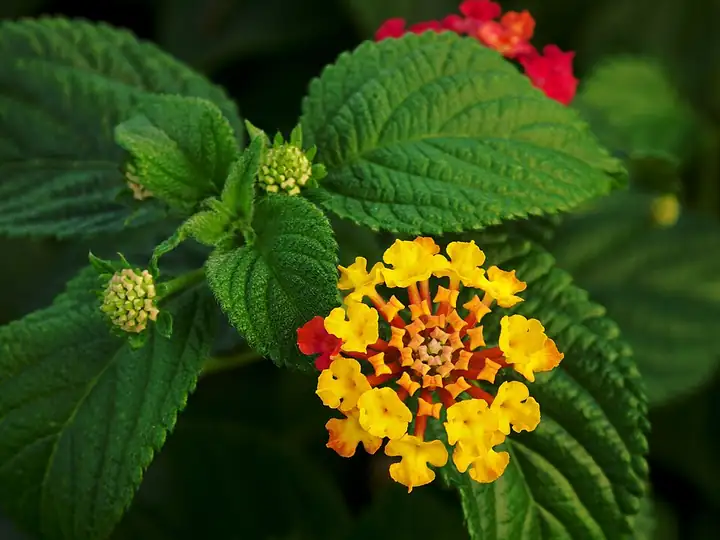
Lantana
Lantana camara
| Type | Shrub or tree |
|---|---|
| Life cycle | Perennial |
| Family | Verbena family (Verbenaceae) |
| Origin | Introduced from elsewhere |
| Most common in | Southeast, Hawaii |
About
A popular flowering shrub that has escaped into the wild in Florida, Hawaii and along the Gulf Coast. It forms dense, prickly thickets, and its leaves and green berries are poisonous to children, pets and livestock.
Also called common lantana, shrub verbena
How to identify it
Look for
A sprawling shrub 1 to 6 feet tall with square, prickly stems and rough, strong-smelling leaves. Rounded clusters of small tubular flowers come in mixed colors such as yellow-orange-red or pink-white. Berries start green and turn shiny blue-black.
Look-alikes
Native lantanas look similar, and invasive lantana can cross with them; sterile, non-fruiting garden varieties don't cross with natives but are still toxic.
Where it grows
Pastures, disturbed ground, old groves, roadsides, woods edges and coastal areas in warm climates; also a common garden plant.
When
Flowers through the warm months and ripens berries in late summer and fall; it stays evergreen in frost-free places.
How it spreads
Birds eat the berries and spread the seeds far from the parent plant.
Most common in
| Northeast | Not found here |
|---|---|
| Southeast | Very common here |
| South Central | Common here |
| Midwest | Not found here |
| Great Plains | Not found here |
| Mountain West | Not found here |
| Southwest | Occasional here |
| Pacific Northwest | Not found here |
| California | Occasional here |
| Alaska | Not found here |
| Hawaii | Very common here |
What to do, gentlest first
Protect yourself first. Weed killers are a last step; always read and follow the label.
Plant sterile or native choices Prevent
In Florida, Hawaii and other warm areas, avoid planting fruiting lantana. Choose sterile varieties or native alternatives.
Sterile varieties are still toxic.
Dig out the whole root By hand
Dig out plants with the entire root system; mowing alone doesn't kill it.
Wear gloves and long sleeves. Bag berries for the trash.
Fluroxypyr in pastures Conventional spray
In pastures, two treatments with fluroxypyr, in fall before frost and again in spring after green-up, can give control.
Read and follow the label. Many lawn and brush herbicides also kill garden plants, so keep spray and drift off anything you want to keep.
Uses, wildlife and pets
For wildlife
Butterflies love the flowers, and birds eat the berries (which is how it spreads).
Pets
Toxic to dogs, cats and horses (ASPCA), with vomiting, diarrhea, labored breathing and weakness; liver failure is more common in livestock.
Sources
- plants.ces.ncsu.edu
- ask.ifas.ufl.edu
- assessment.ifas.ufl.edu
- blogs.ifas.ufl.edu
- www3.ctahr.hawaii.edu
- plantsservices.sc.egov.usda.gov
- aspca.org
Photo: Photo: Alvesgaspar / Wikimedia Commons, CC BY-SA 3.0 (CC BY-SA 3.0). Photo resized for the web.

Planting dates and advice are general guidance; check with your local Cooperative Extension office for your area.