
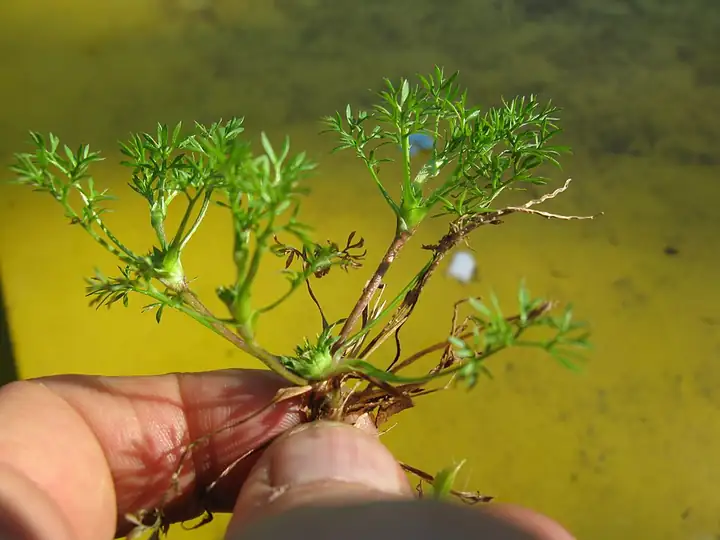
Lawn Burweed
Soliva sessilis
| Type | Broadleaf |
|---|---|
| Life cycle | Winter annual |
| Family | Aster family (Asteraceae) |
| Origin | Introduced from elsewhere |
| Most common in | Southeast, South Central |
About
Lawn burweed is a tiny, parsley-leaved winter weed from South America that hides in thin lawns until spring, when it forms sharp, spiny burs that make going barefoot painful. Once the burs harden, even dead plants stay prickly, so it has to be treated in winter.
Also called spurweed, field burweed, bindi weed, sticker weed, lawn burrweed
How to identify it
Look for
Look for small, flat, freely branching plants with finely divided, sparsely hairy leaves that look like tiny parsley or carrot leaves. The flowers are tiny and easy to miss in the leaf joints. In spring you can feel the hard, spine-tipped burs before you can see them.
Look-alikes
Parsley-piert and knawel look very similar in turf. Pineappleweed and southern brassbuttons are also look-alikes; burweed has hairier leaves and hidden, inconspicuous flowers.
Where it grows
Thin lawns, compacted paths and roadsides, especially in the Southeast, and in parts of California.
When
Seeds sprout in fall (about October to December), plants stay small over winter, bloom in early spring, form burs as it warms, and die in late spring heat.
How it spreads
By seed; the spiny burs stick to shoes, clothing and equipment.
Most common in
| Northeast | Occasional here |
|---|---|
| Southeast | Very common here |
| South Central | Very common here |
| Midwest | Not found here |
| Great Plains | Not found here |
| Mountain West | Not found here |
| Southwest | Occasional here |
| Pacific Northwest | Occasional here |
| California | Common here |
| Alaska | Not found here |
| Hawaii | Occasional here |
What to do, gentlest first
Start at the top. Weed killers are a last step; always read and follow the label.
Keep the lawn thick Prevent
Proper fertilizing, liming and mowing give grass the edge over burweed for light, water and nutrients.
Mowing won't remove it; it grows too flat.
Pull in winter, before burs form By hand
Pull small plants in winter, before the burs develop in spring.
After the burs form, removal is mostly too late; the dried burs stay sharp.
Vinegar on small winter plants Organic spray
Horticultural vinegar can kill the small plants while they are young in winter.
Strong vinegar (over about 11% acetic acid) can burn skin and eyes, so wear gloves and eye protection. It browns any leaves it touches, grass included.
Fall pre-emergent or winter spot spray Conventional spray
An isoxaben pre-emergent in late September to early October, watered in, stops seedlings. For plants already up, spray from December to February with a 2,4-D/MCPP/dicamba mix or metsulfuron; atrazine is an option only on centipedegrass and St. Augustinegrass.
Don't spray during spring green-up of warm-season grass or above 90 °F, and don't reseed within 60 days of isoxaben. Read and follow the label. Many lawn weed killers also harm vegetables, flowers and shrubs, so don't let spray drift into beds, and keep dicamba products off the root zones of trees and shrubs.
Uses, wildlife and pets
Pets
Not listed by the ASPCA. The sharp burs are a nuisance to bare feet, and NC State notes dogs and cats tend to avoid patches.
Sources
- turffiles.ncsu.edu
- ipm.ucanr.edu
- hgic.clemson.edu
- extension.msstate.edu
- plants.ces.ncsu.edu
- extension.umd.edu
- plantsservices.sc.egov.usda.gov
Photo: Photo: Harry Rose / Wikimedia Commons, CC BY 2.0 (CC BY 2.0). Photo resized for the web.

Planting dates and advice are general guidance; check with your local Cooperative Extension office for your area.