
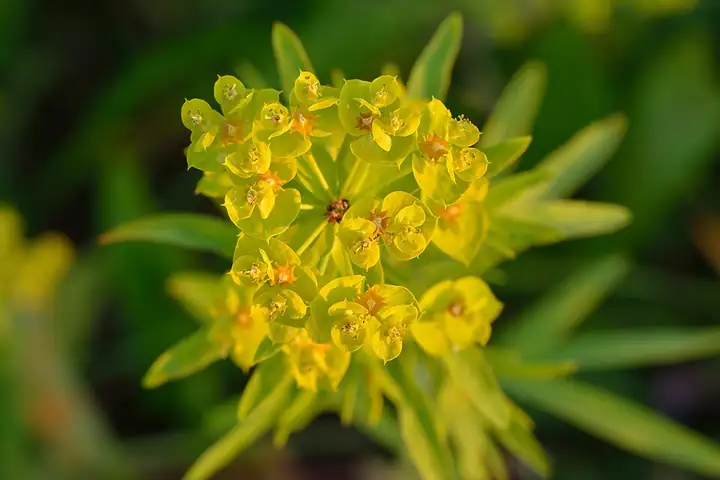
Leafy spurge
Euphorbia esula
| Type | Broadleaf |
|---|---|
| Life cycle | Perennial |
| Family | Spurge family (Euphorbiaceae) |
| Origin | Introduced from elsewhere |
| Most common in | Great Plains, Mountain West |
About
A deep-rooted Eurasian perennial that takes over prairies and pastures, especially on the Northern Plains and in the Mountain West. Its milky sap irritates skin and can badly hurt the eyes, and cattle and horses avoid or are poisoned by it.
Also called wolf's milk
How to identify it
Look for
Smooth, upright stems 1 to 3 feet tall carry narrow, bluish-green leaves 1 to 4 inches long. In late spring, yellow-green, heart-shaped bracts form umbrella-like clusters at the tops. Every part bleeds a white milky sap when broken.
Look-alikes
Eggleaf spurge has oblong, toothed leaves and white stem hairs. Any plant that bleeds milky sap should be handled with gloves and eye protection.
Where it grows
Pastures, prairies, roadsides, ditches and other untilled ground, especially in dry soil.
When
Shoots emerge from mid-April to early May, it flowers from late May into summer, and seeds shoot out through summer.
How it spreads
Seed pods burst and fling seeds up to 15 or 20 feet, seeds live about 7 to 10 years, and its roots reach 15 feet deep and sprout new shoots.
Most common in
| Northeast | Occasional here |
|---|---|
| Southeast | Not found here |
| South Central | Not found here |
| Midwest | Common here |
| Great Plains | Very common here |
| Mountain West | Very common here |
| Southwest | Occasional here |
| Pacific Northwest | Common here |
| California | Occasional here |
| Alaska | Not found here |
| Hawaii | Not found here |
Where it is regulated
Minnesota lists leafy spurge as a Prohibited Control noxious weed and Washington as a Class B noxious weed.
What to do, gentlest first
Protect yourself first. Weed killers are a last step; always read and follow the label.
Protect eyes and stop the spread Prevent
Wear eye protection and gloves near it. Clean mowers and vehicles after use, and don't move hay or soil from infested places.
Mow before it flowers Prevent
Repeated mowing before flowering cuts seed production. Pulling and digging usually fail because the roots run so deep and broken roots resprout.
Mowing won't kill it alone. Bag any plant parts for the trash.
Flea beetles and sheep or goats Natural enemies
Released flea beetles steadily shrink large, stable patches. Sheep and goats graze it well and will eat it repeatedly.
Hold grazing animals before moving them, since seeds ride in coats and droppings.
Picloram, 2,4-D or glyphosate, repeated Conventional spray
Treat in spring and again in fall, when plants move sugars to the roots; picloram works best, and 2,4-D or glyphosate give partial control. It takes years.
Read and follow the label. Many lawn and brush herbicides also kill garden plants, so keep spray and drift off anything you want to keep.
Uses, wildlife and pets
Pets
Not listed by the ASPCA; the Minnesota Department of Agriculture notes it is toxic to cattle and horses.
Sources
- extension.umn.edu
- mda.state.mn.us
- fs.usda.gov
- kingcounty.gov
- mdc.mo.gov
- plantsservices.sc.egov.usda.gov
- aspca.org
Photo: Photo: Ivar Leidus / Wikimedia Commons, CC BY-SA 3.0 (CC BY-SA 3.0). Photo resized for the web.

Planting dates and advice are general guidance; check with your local Cooperative Extension office for your area.