
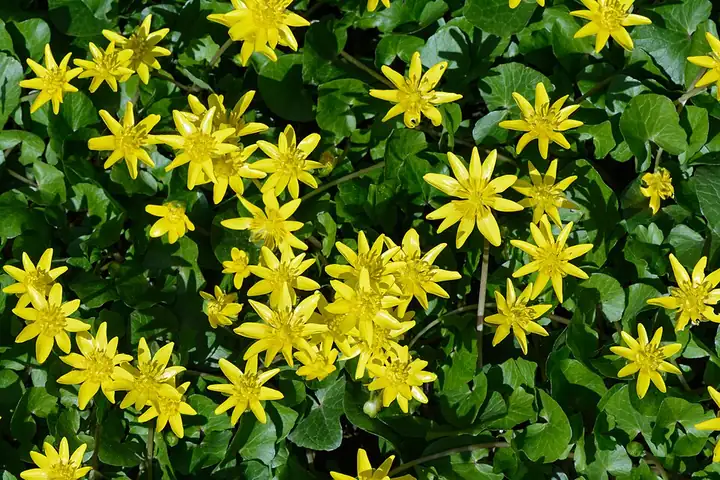
Lesser celandine
Ficaria verna
| Type | Broadleaf |
|---|---|
| Life cycle | Perennial |
| Family | Buttercup family (Ranunculaceae) |
| Origin | Introduced from elsewhere |
| Most common in | Northeast |
About
Lesser celandine is a low spring plant from Europe with glossy leaves and shiny yellow flowers that forms dense carpets on moist, shady ground in early spring. It spreads by tiny tubers and bulblets and is poisonous if eaten raw.
Also called fig buttercup, pilewort, lesser crowfoot
How to identify it
Look for
Plants are only 4 to 12 inches tall, with glossy, dark green, kidney- to heart-shaped leaves. Bright yellow shiny flowers have 8 to 12 petals over three green sepals. Look for small fig-shaped tubers on the roots and tiny pale bulblets where leaves join the stems.
Look-alikes
Native marsh marigold blooms at the same time but has much larger flowers with fewer petals.
Where it grows
Moist, shady soils, especially river floodplains, where it forms large, dense colonies.
When
Leaves come up in late winter, flowers open from about March to May, and the top growth dies back soon after.
How it spreads
Mainly by underground tubers and by bulblets on the stems, both carried by floods and soil; plants make few seeds (up to about 70).
Most common in
| Northeast | Very common here |
|---|---|
| Southeast | Common here |
| South Central | Occasional here |
| Midwest | Common here |
| Great Plains | Occasional here |
| Mountain West | Occasional here |
| Southwest | Occasional here |
| Pacific Northwest | Common here |
| California | Occasional here |
| Alaska | Not found here |
| Hawaii | Not found here |
Where it is regulated
Listed as a restricted noxious weed in Minnesota (sale and propagation prohibited).
What to do, gentlest first
Protect yourself first. Weed killers are a last step; always read and follow the label.
Don't plant or share it Prevent
Don't buy, plant or trade it, and don't move soil from infested areas.
Dig small patches carefully By hand
Dig out small patches with all tubers and bulblets and bag everything for the trash; expect to repeat for several years.
Don't mow; wear gloves.
Systemic herbicide in early spring Conventional spray
Large patches need a systemic herbicide while plants are actively growing in late winter to early spring, usually over several years; hiring a qualified professional is best.
Read and follow the label; many lawn and brush herbicides also kill garden plants.
Uses, wildlife and pets
Pets
Toxic to dogs, cats and horses (ASPCA lists buttercups, Ranunculus, the genus this plant was long placed in): vomiting, diarrhea, drooling, mouth ulcers and a wobbly gait.
Sources
Photo: Photo: Uoaei1 / Wikimedia Commons, CC BY-SA 4.0 (CC BY-SA 4.0). Photo resized for the web.

Planting dates and advice are general guidance; check with your local Cooperative Extension office for your area.