
Mile-a-minute
Polygonum perfoliatum
| Type | Vine |
|---|---|
| Life cycle | Summer annual |
| Family | Buckwheat family (Polygonaceae) |
| Origin | Introduced from elsewhere |
| Most common in | Northeast |
About
A barbed annual vine from Asia that can grow up to 6 inches a day and pile over shrubs, young trees and garden edges. It dies each fall, but seeds last several years in the soil, so it comes back every spring.
Also called mile-a-minute weed, mile-a-minute vine, Asiatic tearthumb, devil's tearthumb
How to identify it
Look for
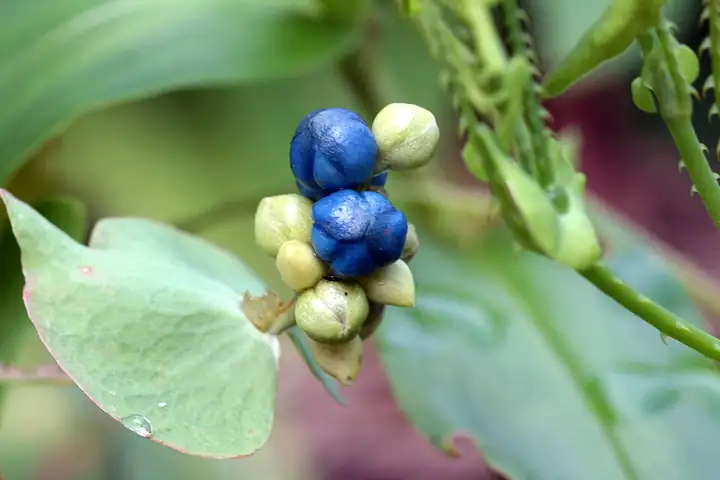
Leaves are distinctly triangular, 1 to 3 inches wide, with tiny hooked barbs under the midrib and on the leaf stalks. Round, saucer-like leafy collars (ocreae) circle the stem at the leaf joints, and the thin stems are covered in small recurved barbs. Clusters of metallic blue berries about a quarter inch across form from late summer into fall.
Where it grows
Sunny, moist spots: forest edges, stream banks, wetlands, roadsides and garden edges.
When
Seeds sprout in early April, plants flower from June or July, and berries ripen from about September to November.
How it spreads
By seed carried by birds, mammals and water (seeds can float for days) and in moved soil; seeds stay alive in the soil for several years.
Most common in
| Northeast | Very common here |
|---|---|
| Southeast | Common here |
| South Central | Not found here |
| Midwest | Occasional here |
| Great Plains | Not found here |
| Mountain West | Not found here |
| Southwest | Not found here |
| Pacific Northwest | Occasional here |
| California | Not found here |
| Alaska | Not found here |
| Hawaii | Not found here |
Where it is regulated
Pennsylvania lists it as a Class B noxious weed.
What to do, gentlest first
Start at the top. Weed killers are a last step; always read and follow the label.
Shade it out and don't move infested soil Prevent
It needs sun, so planting trees and shrubs that shade the ground helps over time. Watch for seedlings every spring.
Pull before berries form By hand
Pull vines in late spring and early summer, finishing before July, before berries form. If berries are already on, bag the plants and put them in the trash.
Wear leather gloves and long sleeves; the barbs scratch.
Mile-a-minute weevil Natural enemies
A tiny weevil, Rhinoncomimus latipes, approved in 2004, feeds on the leaves and stems and can badly stunt the vine. It won't wipe it out.
Pre-emergent in March, or triclopyr on young vines Conventional spray
A prodiamine or pendimethalin pre-emergent applied a few weeks before seeds sprout (usually by mid-March) stops seedlings. Triclopyr sprayed on young vines spares lawn grasses; glyphosate is nonselective.
Read and follow the label. Many lawn and brush killers also harm garden plants, so keep spray and drift off anything you want to keep.
Uses, wildlife and pets
For wildlife
Birds and mammals eat the fruit, which helps spread it.
Pets
Not listed as toxic by the ASPCA
Sources
Photo: Photo: Dalgial / Wikimedia Commons, CC BY 3.0 (CC BY 3.0). Photo resized for the web.

Planting dates and advice are general guidance; check with your local Cooperative Extension office for your area.