
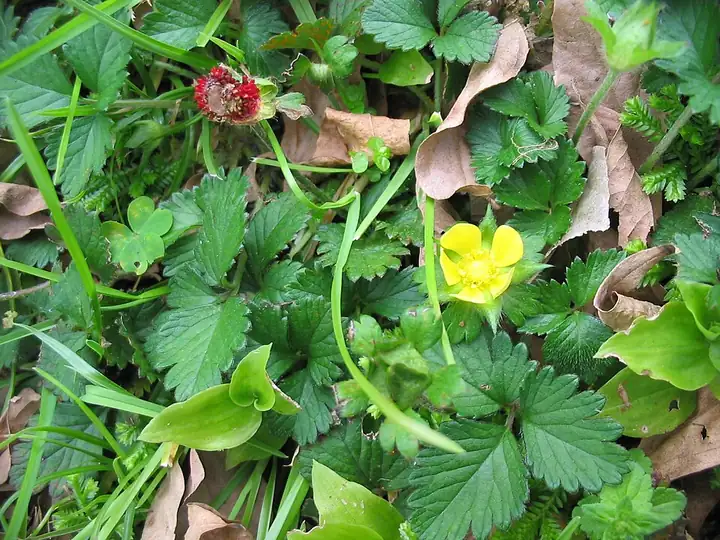
Mock Strawberry
Potentilla indica
| Type | Broadleaf |
|---|---|
| Life cycle | Perennial |
| Family | Rose family (Rosaceae) |
| Origin | Introduced from elsewhere |
| Most common in | Northeast, Southeast |
About
Mock strawberry is a low, creeping Asian plant with yellow flowers and small red berries that runs through shady, damp lawns. It looks like a wild strawberry, but the fruit is dry and bland.
Also called Indian mock strawberry, Indian strawberry, Indian mock-strawberry
How to identify it
Look for
Leaves have three round-toothed, oval leaflets that are hairy on top, on a plant that trails along the ground. Hairy runners root to form chains of new plants. Single yellow five-petaled flowers on long stalks are followed by small, bright red, strawberry-like fruits.
Look-alikes
Wild strawberry has white flowers and sharp-pointed leaf teeth; mock strawberry's flowers are yellow and its teeth are rounded.
Where it grows
Moist, shady or poorly drained lawns and bed edges; it tolerates close mowing.
When
A perennial that keeps spreading by runners through the growing season, with yellow flowers followed by red fruits.
How it spreads
Rooting runners (stolons) and seeds.
Most common in
| Northeast | Very common here |
|---|---|
| Southeast | Very common here |
| South Central | Common here |
| Midwest | Common here |
| Great Plains | Occasional here |
| Mountain West | Occasional here |
| Southwest | Occasional here |
| Pacific Northwest | Occasional here |
| California | Occasional here |
| Alaska | Not found here |
| Hawaii | Not found here |
What to do, gentlest first
Start at the top. Weed killers are a last step; always read and follow the label.
Improve drainage and water less often Prevent
Better surface drainage, aerating when needed and less frequent watering all slow its spread; keep turf dense.
Pull the runners early By hand
Pull or dig plants and their rooted runners as soon as you notice them, when the soil is moist.
Vinegar only burns the tops Organic spray
Horticultural vinegar may kill young plants, but established ones regrow from their runners and roots.
Strong vinegar (over about 11% acetic acid) can burn skin and eyes, so wear gloves and eye protection. It browns any leaves it touches, grass included.
Broadleaf lawn herbicide Conventional spray
Spot-treat actively growing plants with a lawn product containing 2,4-D, MCPP (mecoprop), dicamba or triclopyr.
Read and follow the label. Many lawn weed killers also harm vegetables, flowers and shrubs, so don't let spray drift into beds, and keep dicamba products off the root zones of trees and shrubs.
Uses, wildlife and pets
Edible?
NC State says the fruit is technically edible but has a bland flavor and dry texture. Only pick from unsprayed ground.
Not 100% sure? Don't eat it. Never pick from ground that may have been sprayed, or along roads and railways.
Pets
Not listed by the ASPCA. The ASPCA lists true wild strawberry (Fragaria) as non-toxic to dogs, cats and horses, but that is a different plant.
Sources
- turffiles.ncsu.edu
- extension.umd.edu
- plants.ces.ncsu.edu
- extension.umd.edu
- npgsweb.ars-grin.gov
- plantsservices.sc.egov.usda.gov
- aspca.org
Photo: Photo: Ixitixel / Wikimedia Commons, CC BY-SA 3.0 (CC BY-SA 3.0). Photo resized for the web.

Planting dates and advice are general guidance; check with your local Cooperative Extension office for your area.