
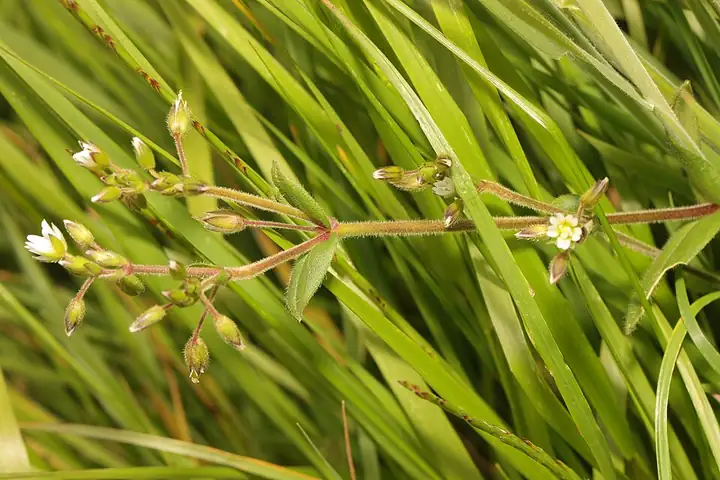
Mouseear Chickweed
Cerastium fontanum
| Type | Broadleaf |
|---|---|
| Life cycle | Perennial |
| Family | Pink family (Caryophyllaceae) |
| Origin | Introduced from elsewhere |
| Most common in | Northeast, Pacific Northwest |
About
Mouseear chickweed is a fuzzy, low, spreading chickweed that forms dense patches in lawns. Unlike common chickweed it is usually a perennial, so patches come back year after year and survive close mowing.
Also called mouse-ear chickweed, common mouse-ear chickweed, mouseear
How to identify it
Look for
Leaves grow in pairs, are oval and stalkless, and are dark or gray-green and covered in soft hairs, like a mouse's ear. Hairy stems creep along the ground and root at the joints. Small white flowers have five notched petals.
Look-alikes
Common chickweed has smooth, lighter green leaves with only a line of hairs on the stem; sticky chickweed is another hairy look-alike.
Where it grows
Thin, moist lawns, especially shady and frequently watered ones, plus gardens, roadsides and damp woods.
When
It blooms from about March to August; in warmer areas, such as eastern North Carolina, it can act like a winter annual.
How it spreads
Seeds, plus creeping stems that root at the joints.
Most common in
| Northeast | Very common here |
|---|---|
| Southeast | Common here |
| South Central | Occasional here |
| Midwest | Common here |
| Great Plains | Occasional here |
| Mountain West | Common here |
| Southwest | Occasional here |
| Pacific Northwest | Very common here |
| California | Common here |
| Alaska | Common here |
| Hawaii | Occasional here |
What to do, gentlest first
Start at the top. Weed killers are a last step; always read and follow the label.
Thicken turf, reduce shade and watering Prevent
Keep grass dense, let more light in where you can, and water less often.
Mowing lower won't help; it survives close mowing.
Pull or dig patches By hand
Lift patches with a weeding tool when the soil is moist, getting the rooted stems.
Mulch beds Barrier
Keep 2 to 3 inches of mulch in garden beds.
Vinegar on seedlings Organic spray
Horticultural vinegar can kill small seedlings; established perennial patches tend to regrow.
Strong vinegar (over about 11% acetic acid) can burn skin and eyes, so wear gloves and eye protection. It browns any leaves it touches, grass included.
Broadleaf lawn herbicide Conventional spray
Spot-treat actively growing plants with a lawn broadleaf weed killer whose label lists mouseear chickweed.
Read and follow the label. Many lawn weed killers also harm vegetables, flowers and shrubs, so don't let spray drift into beds, and keep dicamba products off the root zones of trees and shrubs.
Uses, wildlife and pets
Pets
Not listed by the ASPCA.
Sources
Photo: Photo: Stephen James McWilliam / Wikimedia Commons, CC0 (CC0). Photo resized for the web.

Planting dates and advice are general guidance; check with your local Cooperative Extension office for your area.