
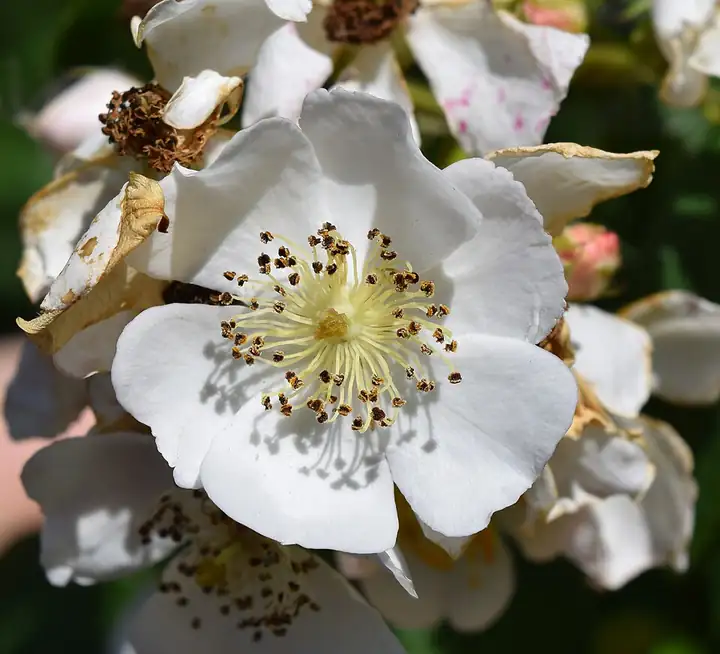
Multiflora rose
Rosa multiflora
| Type | Shrub or tree |
|---|---|
| Life cycle | Perennial |
| Family | Rose family (Rosaceae) |
| Origin | Introduced from elsewhere |
| Most common in | Northeast, Southeast, Midwest |
About
An Asian rose once planted for hedges and wildlife that now forms thorny thickets more than 10 feet tall and 20 feet wide. It crowds out pastures, woods and yard edges, and one plant can make hundreds of thousands of seeds a year.
How to identify it
Look for
Long arching green canes carry stout, curved thorns. Each leaf has 5 to 11 (usually 7 or 9) toothed leaflets, and a fringed stipule where the leaf meets the stem. Clusters of small, fragrant white to pale pink flowers in May and June become tiny red hips about a quarter inch across that last into winter.
Look-alikes
Native roses such as pasture, swamp and Virginia rose have pink flowers and smooth stipules. Native black raspberry and blackberries have red or purple canes and make berries, not rose hips.
Where it grows
Fence rows, pastures, woodland edges, roadsides and neglected yard corners.
When
Flowers from late April through June; hips ripen by late summer and often hang on until spring.
How it spreads
By seed that birds spread (up to about 500,000 seeds per plant a year, lasting 10 to 20 years in soil) and by canes that root where their tips touch the ground.
Most common in
| Northeast | Very common here |
|---|---|
| Southeast | Very common here |
| South Central | Common here |
| Midwest | Very common here |
| Great Plains | Common here |
| Mountain West | Occasional here |
| Southwest | Not found here |
| Pacific Northwest | Occasional here |
| California | Occasional here |
| Alaska | Not found here |
| Hawaii | Not found here |
Where it is regulated
Wisconsin, Missouri, Pennsylvania, Virginia and West Virginia list it as a noxious weed; Iowa lists it as a secondary noxious weed and Minnesota as a restricted noxious weed.
What to do, gentlest first
Start at the top. Weed killers are a last step; always read and follow the label.
Pull seedlings early Prevent
It's easiest to control when plants are young and newly found. Check fence lines every year for seedlings.
Dig out small plants; mow big patches often By hand
Dig small plants with their crowns. For larger patches, mow or cut up to 6 times a season for 2 to 4 years.
Wear heavy gloves and long sleeves for the thorns. Bulldozing stirs up seeds and resprouts.
Goats Natural enemies
Goats browse it heavily and nearly wiped it out within 4 seasons in one study. Rose rosette disease and a seed-eating wasp also weaken wild stands.
Glyphosate or triclopyr on cut stems or leaves Conventional spray
Paint freshly cut stems or spray leaves and new growth; fall glyphosate treatments give control the next spring. Dicamba also works.
Read and follow the label. Many lawn and brush killers also harm garden plants, so keep spray and drift off anything you want to keep.
Uses, wildlife and pets
For wildlife
Grouse, turkeys, cedar waxwings and robins eat the hips, and thickets give winter cover.
Pets
Not listed as toxic by the ASPCA
Sources
- fs.usda.gov
- extension.umd.edu
- extension.psu.edu
- extension.umn.edu
- plantsservices.sc.egov.usda.gov
- aspca.org
Photo: Photo: Fredlyfish4 / Wikimedia Commons, CC BY-SA 4.0 (CC BY-SA 4.0). Photo resized for the web.

Planting dates and advice are general guidance; check with your local Cooperative Extension office for your area.