
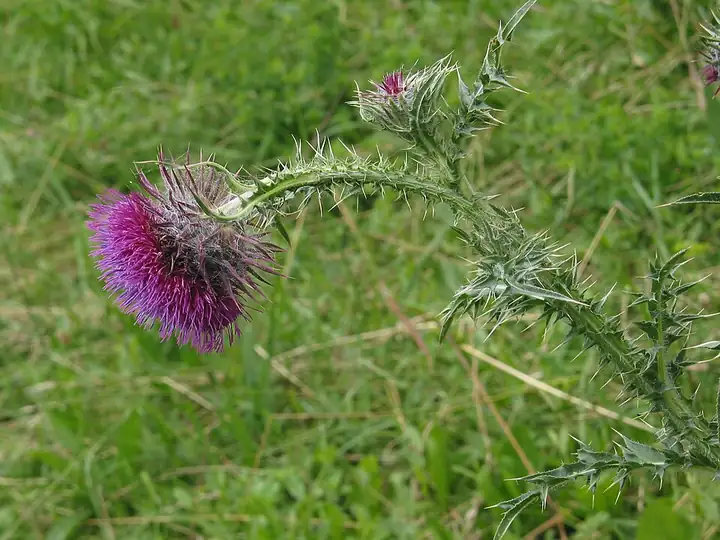
Musk thistle
Carduus nutans
| Type | Broadleaf |
|---|---|
| Life cycle | Biennial |
| Family | Aster family (Asteraceae) |
| Origin | Introduced from elsewhere |
| Most common in | Great Plains |
About
Musk thistle is a tall, spiny biennial from Europe and Asia with big nodding purple flower heads. It is a state noxious weed in many places and can take over pastures, roadsides and weedy lots.
Also called nodding thistle, nodding plumeless thistle
How to identify it
Look for
First-year rosettes have dark green, deeply lobed, spiny leaves with a light-colored midrib. The second year, spiny-winged stems grow 2 to 7 feet tall and carry large single flower heads up to about 3 inches across that droop, with broad spine-tipped bracts underneath.
Look-alikes
Bull thistle has smaller upright heads and woolly leaf undersides; Canada thistle has small clustered heads and spreads in patches from roots.
Where it grows
Pastures, rangeland, roadsides, ditch banks, hayfields and disturbed ground.
When
Rosettes form in the first year (or from fall sprouts), bolt the next spring and flower from about June into summer before dying.
How it spreads
Only by seed: a plant may carry 50 to 100 flower heads and 10,000 or more seeds, most landing within about 160 feet.
Most common in
| Northeast | Occasional here |
|---|---|
| Southeast | Common here |
| South Central | Common here |
| Midwest | Common here |
| Great Plains | Very common here |
| Mountain West | Common here |
| Southwest | Occasional here |
| Pacific Northwest | Occasional here |
| California | Occasional here |
| Alaska | Not found here |
| Hawaii | Not found here |
Where it is regulated
Listed as a noxious weed in Colorado (List B), Washington (Class B), Nebraska and Oklahoma.
What to do, gentlest first
Start at the top. Weed killers are a last step; always read and follow the label.
Keep ground covered Prevent
Thick grass or planting keeps seedlings from getting started; cultivation kills young seedlings.
Dig or cut below the crown By hand
Cut rosettes or bolting plants off below the soil line with a spade or hoe. If flowering, cut plants when the first heads are in bud or early bloom and bag the heads.
Wear heavy gloves; plants cut too early may regrow, so check back.
Spray rosettes spring or fall Conventional spray
Herbicides such as 2,4-D, dicamba, triclopyr, clopyralid or aminopyralid work best on rosettes before bolting, in spring or fall.
Read and follow the label; many lawn and brush herbicides also kill garden plants.
Uses, wildlife and pets
Pets
Not listed by the ASPCA.
Sources
- nwcb.wa.gov
- cropwatch.unl.edu
- dnr.state.mn.us
- extension.okstate.edu
- ag.colorado.gov
- plantsservices.sc.egov.usda.gov
- aspca.org
Photo: Photo: Robert Flogaus-Faust / Wikimedia Commons, CC BY 4.0 (CC BY 4.0). Photo resized for the web.

Planting dates and advice are general guidance; check with your local Cooperative Extension office for your area.