
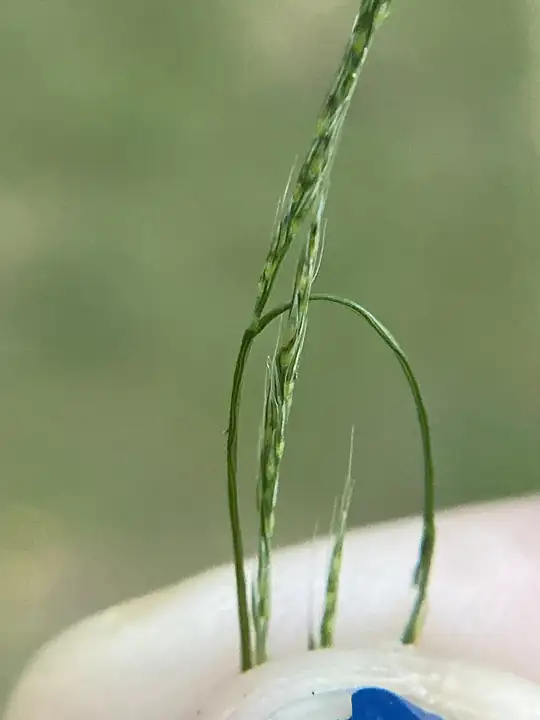
Nimblewill
Muhlenbergia schreberi
| Type | Grass |
|---|---|
| Life cycle | Perennial |
| Family | Grass family (Poaceae) |
| Origin | Native to the US |
| Most common in | Northeast, Midwest |
About
A native warm-season perennial grass that forms thin, wiry patches in cool-season lawns. The patches turn tan in fall and green up late in spring, so they look like dead spots for months.
How to identify it
Look for
Short (3/4 to 2 inch), blue-green or gray-green pointed leaves stick out from thin, wiry stems like the rungs of a ladder. The ligule is a tiny membrane, and stems sprawl and root at the joints. Narrow seedheads appear from midsummer with tiny seeds that carry long hair-like awns.
Look-alikes
Bermudagrass has a ring of hairs where the blade meets the stem and deep rhizomes. Creeping bentgrass and Japanese stiltgrass also look similar; stiltgrass has a silvery stripe down the leaf.
Where it grows
Shady, moist lawns and low-maintenance turf, plus field edges and woodland openings.
When
Greens up late in spring, grows fast in summer, sets seed from midsummer through October, and goes dormant in late fall.
How it spreads
Spreads by seed and by stolons that root at the joints, and mowers, shoes and moved soil carry it around.
Most common in
| Northeast | Very common here |
|---|---|
| Southeast | Common here |
| South Central | Common here |
| Midwest | Very common here |
| Great Plains | Occasional here |
| Mountain West | Occasional here |
| Southwest | Occasional here |
| Pacific Northwest | Occasional here |
| California | Occasional here |
| Alaska | Not found here |
| Hawaii | Not found here |
What to do, gentlest first
Start at the top. Weed killers are a last step; always read and follow the label.
Keep the lawn dense Prevent
Choose grass suited to the site, mow at the right height, fertilize and lime by soil test, and bag clippings when weedy grasses are seeding.
Pull small patches before they seed By hand
Hand-pull or dig small patches before seedheads form, getting the rooted runners.
Mesotrione or topramezone in cool-season lawns Conventional spray
Mesotrione or topramezone can selectively control it in cool-season lawns with 2 to 3 applications. Or spray glyphosate 2 to 3 times on green, growing plants, then reseed.
Read and follow the label. Many lawn herbicides kill garden plants, so keep spray and drift off beds and vegetables. Glyphosate kills the lawn too, and the area will look dead for weeks.
Uses, wildlife and pets
Pets
Not listed as toxic to dogs, cats or horses by the ASPCA.
Sources
- content.ces.ncsu.edu
- extension.psu.edu
- turf.purdue.edu
- extension.illinois.edu
- plantsservices.sc.egov.usda.gov
- aspca.org
- aspca.org
- aspca.org
Photo: Photo: Emily Summerbell / Wikimedia Commons, CC BY 4.0 (CC BY 4.0). Photo resized for the web.

Planting dates and advice are general guidance; check with your local Cooperative Extension office for your area.