
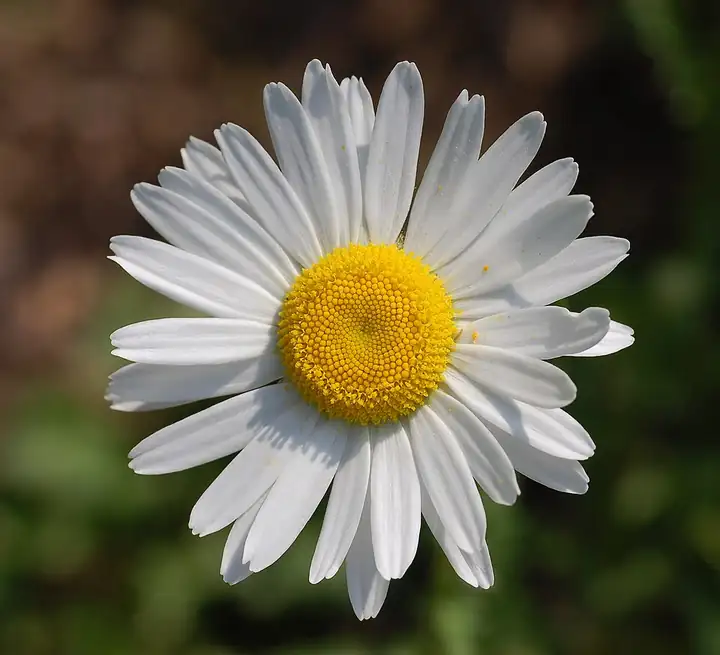
Oxeye daisy
Leucanthemum vulgare
| Type | Broadleaf |
|---|---|
| Life cycle | Perennial |
| Family | Aster family (Asteraceae) |
| Origin | Introduced from elsewhere |
| Most common in | Northeast, Midwest, Mountain West, Pacific Northwest |
About
Oxeye daisy is a pretty European daisy that spreads into pastures, meadows, grasslands and roadsides. It spreads by shallow rhizomes and huge numbers of long-lived seeds, and several states list it as a noxious weed.
Also called ox-eye daisy, field daisy, white daisy, whiteweed, marguerite
How to identify it
Look for
Flower heads are 1 to 2 inches across with white rays around a yellow center, one per stem, on plants 1 to 3 feet tall. Lower leaves are spoon-shaped, toothed or lobed and on stalks; upper leaves are smaller and attach directly to the stem. The plant has a strong, harsh smell and shallow rhizomes.
Look-alikes
Shasta daisy is taller with flowers over 2 inches, less-lobed lower leaves and fibrous roots. Scentless chamomile has smaller flowers and finely divided, fern-like leaves.
Where it grows
Pastures, meadows, grasslands, roadsides, rail lines and other open, disturbed ground.
When
Grows from early spring and flowers from about May through August.
How it spreads
By shallow rhizomes and by seed: 1,300 to 26,000 seeds per plant, most lasting at least 6 years and some nearly 40.
Most common in
| Northeast | Very common here |
|---|---|
| Southeast | Common here |
| South Central | Occasional here |
| Midwest | Very common here |
| Great Plains | Occasional here |
| Mountain West | Very common here |
| Southwest | Occasional here |
| Pacific Northwest | Very common here |
| California | Common here |
| Alaska | Occasional here |
| Hawaii | Occasional here |
Where it is regulated
Listed as a noxious weed in Colorado (List B), Washington (Class C) and Montana.
What to do, gentlest first
Start at the top. Weed killers are a last step; always read and follow the label.
Don't plant it; keep plantings thick Prevent
Don't plant oxeye daisy, and keep meadows, pastures and beds thick and healthy so it has a hard time moving back in.
Pull or dig; mow at bud stage By hand
Roots are shallow, so pulling or digging small patches works well. Mow larger patches as soon as flower buds form to stop seed.
Bag flowering plants; don't compost seed heads.
Selective herbicide in pastures Conventional spray
In pastures and rough areas, aminopyralid or metsulfuron are used.
Read and follow the label; many lawn and brush herbicides also kill garden plants. These are not for vegetable gardens.
Uses, wildlife and pets
For wildlife
Butterflies, moths, bees, flies and beetles visit the flowers.
Pets
Not listed by name by the ASPCA, but its 'Daisy (Chrysanthemum)' entry, the genus this plant was once placed in, is toxic to dogs, cats and horses; NC State notes oxeye daisy can cause drooling, vomiting, diarrhea, poor coordination and skin irritation in cats and dogs.
Sources
- plants.ces.ncsu.edu
- nwcb.wa.gov
- montana.edu
- ag.colorado.gov
- plantsservices.sc.egov.usda.gov
- aspca.org
- aspca.org
- aspca.org
Photo: Photo: Derek Ramsey (Ram-Man) / Wikimedia Commons, CC BY-SA 3.0 (CC BY-SA 3.0). Photo resized for the web.

Planting dates and advice are general guidance; check with your local Cooperative Extension office for your area.