
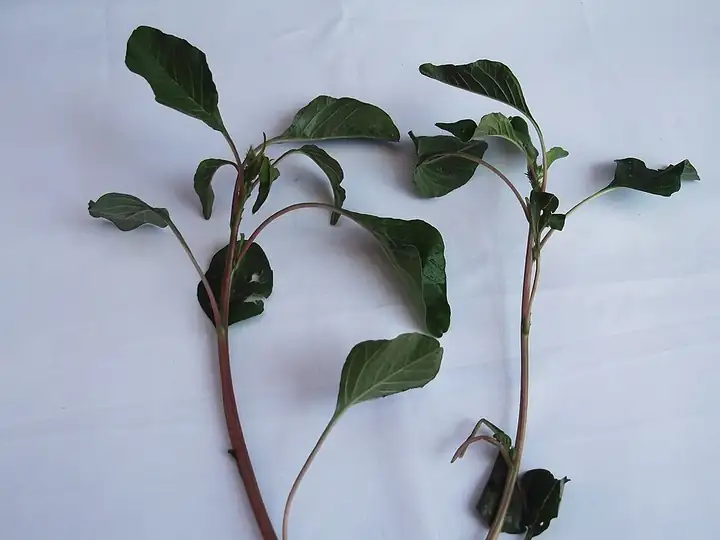
Palmer amaranth
Amaranthus palmeri
| Type | Broadleaf |
|---|---|
| Life cycle | Summer annual |
| Family | Amaranth family (Amaranthaceae) |
| Origin | Native to the US |
| Most common in | Southeast, South Central, Southwest |
About
Palmer amaranth is a pigweed from the desert Southwest that has become one of the worst farm weeds in the South and is spreading north. It can grow 2 to 3 inches a day, makes hundreds of thousands of seeds, and many populations resist several kinds of herbicide.
Also called carelessweed
How to identify it
Look for
Stems and leaves are smooth, with few or no hairs, and the leaf stalks are as long as or longer than the leaf blade; from above, the plant looks like a poinsettia. Some leaves have a white V mark or a single hair at the tip. Male and female flowers grow on separate plants, and the long seed spikes on female plants have stiff, sharp bracts.
Look-alikes
Waterhemp is also hairless but has longer, narrower leaves on shorter stalks; redroot and smooth pigweed have hairy stems. Seedlings of all these pigweeds are very hard to tell apart.
Where it grows
Crop fields, gardens, field edges and roadsides; it can arrive in contaminated seed mixes, feed, hay, manure or on equipment.
When
Sprouts from spring through late summer in warm soil; flowers from about July to November, and viable seed forms just 2 to 3 weeks after flowering.
How it spreads
Seed only: an uncrowded female plant can make 200,000 to over 600,000 seeds, and pollen carrying herbicide resistance can blow at least 980 feet.
Most common in
| Northeast | Occasional here |
|---|---|
| Southeast | Very common here |
| South Central | Very common here |
| Midwest | Common here |
| Great Plains | Common here |
| Mountain West | Occasional here |
| Southwest | Very common here |
| Pacific Northwest | Occasional here |
| California | Common here |
| Alaska | Not found here |
| Hawaii | Not found here |
Where it is regulated
Listed as a noxious weed in Delaware, Minnesota and Ohio (USDA NRCS); in Minnesota it is a prohibited-eradicate weed that must be destroyed and reported.
What to do, gentlest first
Start at the top. Weed killers are a last step; always read and follow the label.
Keep it out and report it Prevent
Buy clean, tested seed, especially wildflower and native seed mixes, and watch new plantings. Outside the South, report suspected plants to your state department of agriculture or extension office (in Minnesota, the Department of Agriculture at 1-888-545-6684).
Pull every plant before it seeds By hand
Pull the whole plant, root and all, before flowers form. Put plants in a bag and get them out of the garden; don't leave them on the ground.
Wear gloves; the bracts on female plants are sharp. Pulled plants can still ripen seed, so never compost them. Keep watching the spot for several years.
Smother with thick mulch Barrier
Heavy mulch or a thick layer of cut cover-crop residue cuts emergence a lot; in trials, rye mulch reduced Palmer amaranth by more than 70 percent.
Burn down seedlings with a contact spray Organic spray
Horticultural vinegar (acetic acid), fatty-acid soap, pelargonic acid or clove-oil sprays burn what they touch within hours. They work best on very young seedlings in warm, sunny weather, and you will need to repeat, because they don't move into roots and bigger plants regrow.
They kill any plant they touch, so shield crops. Strong vinegar can burn skin and eyes; wear goggles and gloves and follow the label.
Get local advice before spraying Conventional spray
Many populations resist glyphosate, ALS inhibitors and several other herbicide groups, so a spray may not work. Ask your extension office which pre-emergent and post-emergent products still work in your area.
Read and follow the label. Many lawn weed killers also kill or damage vegetables and flowers, so keep spray and drift off garden plants.
Uses, wildlife and pets
Pets
Not listed by the ASPCA. Livestock that eat large amounts for days can develop kidney problems (SARE).
Sources
- ipm.ucanr.edu
- sare.org
- crops.extension.iastate.edu
- nrcs.usda.gov
- extension.umn.edu
- plantsservices.sc.egov.usda.gov
- ucanr.edu
Photo: Photo: Yercaud-elango / Wikimedia Commons, CC BY-SA 4.0 (CC BY-SA 4.0). Photo resized for the web.

Planting dates and advice are general guidance; check with your local Cooperative Extension office for your area.