
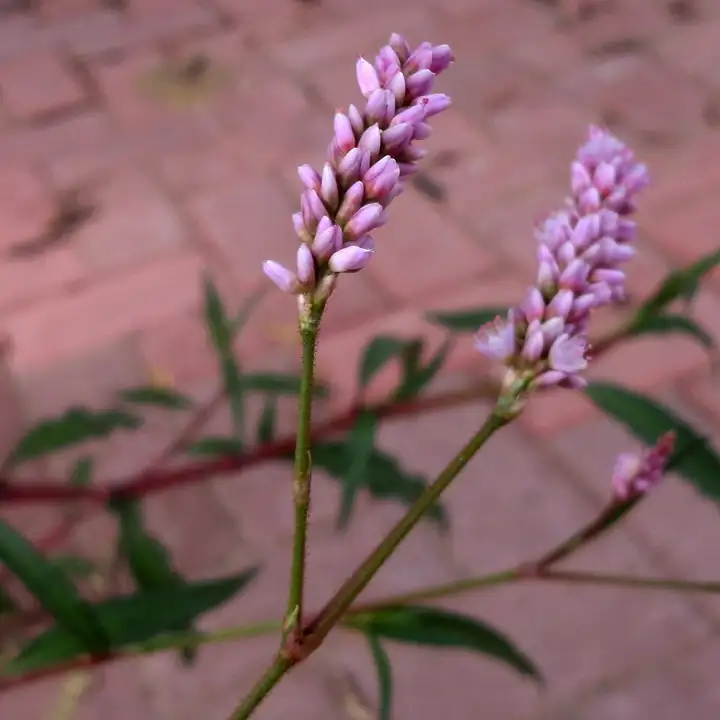
Pennsylvania smartweed
Persicaria pensylvanica
| Type | Broadleaf |
|---|---|
| Life cycle | Summer annual |
| Family | Buckwheat family (Polygonaceae) |
| Origin | Native to the US |
| Most common in | Northeast, Southeast, Midwest |
About
Pennsylvania smartweed is a native annual of moist ground with pink flower spikes, common from the East Coast to the prairies. It is a weed in wet garden spots and fields, but its seeds are valuable food for migrating birds.
Also called smartweed, pinkweed, purple head, glandular persicary, swamp persicary
How to identify it
Look for
Stems have swollen joints, each wrapped by a papery sheath (ocrea) that has no bristles on top. Leaves are lance shaped, 2 to 6 inches long, sometimes with a faint dark blotch. Dense spikes of pink or white flowers sit on stalks that are hairy and often a little sticky.
Look-alikes
Ladysthumb looks almost the same, but its stem sheaths have a fringe of short bristles on top and its leaf blotch is usually darker; pale smartweed lacks the blotch.
Where it grows
Moist garden spots, low field areas, ditches, pond edges and wetlands; it tolerates wet soil better than dry.
When
Sprouts in early to late spring, starts flowering 6 to 9 weeks later and keeps setting seed from July into fall.
How it spreads
Seed only: up to about 100,000 on a lone plant but far fewer under crowding; seeds can survive decades buried.
Most common in
| Northeast | Very common here |
|---|---|
| Southeast | Very common here |
| South Central | Common here |
| Midwest | Very common here |
| Great Plains | Common here |
| Mountain West | Occasional here |
| Southwest | Occasional here |
| Pacific Northwest | Occasional here |
| California | Occasional here |
| Alaska | Occasional here |
| Hawaii | Not found here |
What to do, gentlest first
Start at the top. Weed killers are a last step; always read and follow the label.
Plant warm-season crops after the spring flush Prevent
Almost all seedlings are up by late spring, so working the soil just before planting warm-season crops like tomatoes clears most of the year's flush.
Hoe or bury seedlings By hand
Hoe seedlings, or pull plants before they flower; throwing 2 inches of soil over tiny seedlings in a row buries most of them.
Mulch Barrier
Organic or synthetic mulches suppress smartweeds well.
Corn gluten meal pre-emergent Organic spray
Iowa State lists smartweed among the weeds corn gluten meal can stop as they sprout. Spread it before the weed seeds germinate (about 20 pounds per 1,000 square feet) and water it in lightly; it does nothing to plants that are already up.
It also stops seeds you sow, so don't use it where you plan to plant seeds soon. Heavy rain right after spreading weakens it.
Burn down seedlings with a contact spray Organic spray
Horticultural vinegar (acetic acid), fatty-acid soap, pelargonic acid or clove-oil sprays burn what they touch within hours. They work best on young seedlings in warm, sunny weather, and you will need to repeat, because they don't move into roots and bigger plants regrow.
They kill any plant they touch, so shield crops. Strong vinegar can burn skin and eyes; wear goggles and gloves and follow the label.
Spot spray young plants Conventional spray
In beds, glyphosate as a spot spray on the weed only; in lawns, a broadleaf herbicide such as 2,4-D.
Read and follow the label. Many lawn weed killers also kill or damage vegetables and flowers, so keep spray and drift off garden plants. Don't spray near ponds or wetlands unless the product is labeled for water.
Uses, wildlife and pets
For wildlife
Its abundant, nutritious seeds feed migrating birds and other wildlife, and birds and cottontail rabbits eat them (SARE).
Pets
Not listed by the ASPCA.
Sources
- sare.org
- crops.extension.iastate.edu
- ipm.ucanr.edu
- plantsservices.sc.egov.usda.gov
- yardandgarden.extension.iastate.edu
- ipm.ucanr.edu
- ucanr.edu
Photo: Photo: Juan Carlos Fonseca Mata / Wikimedia Commons, CC BY-SA 4.0 (CC BY-SA 4.0). Photo resized for the web.

Planting dates and advice are general guidance; check with your local Cooperative Extension office for your area.