
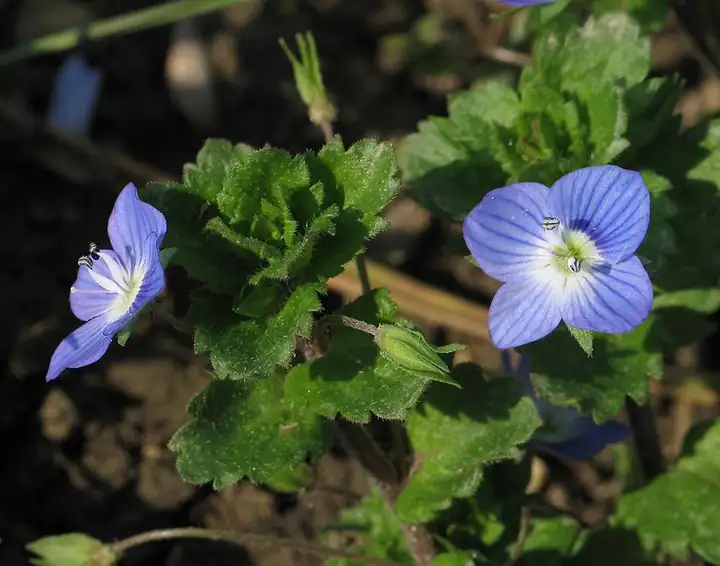
Persian Speedwell
Veronica persica
| Type | Broadleaf |
|---|---|
| Life cycle | Winter annual |
| Family | Plantain family (Plantaginaceae) |
| Origin | Introduced from elsewhere |
| Most common in | Northeast, Pacific Northwest |
About
Persian speedwell is a low, hairy, sprawling weed with small sky-blue flowers that shows up in thin lawns and beds in spring. It tolerates many herbicides, so thick turf is the best defense.
Also called birdeye speedwell, bird's-eye speedwell, common field speedwell, large field speedwell, winter speedwell
How to identify it
Look for
Leaves are small, rounded and coarsely toothed, paired low on the stem and alternate higher up, and the whole plant is hairy. Single light-blue flowers with dark stripes and a white center sit on long, slender stalks from the leaf joints. Seed pods are flat and heart-shaped.
Look-alikes
Corn speedwell has flowers on very short stalks; ivyleaf speedwell has thicker, less toothed leaves; thymeleaf speedwell is nearly hairless.
Where it grows
Thin lawns, bed edges, sidewalks and gardens with moist soil, in sun or part shade.
When
Seeds sprout in fall or winter; it blooms from late winter through spring and fades in summer heat.
How it spreads
By seed; stems can also root at the joints.
Most common in
| Northeast | Very common here |
|---|---|
| Southeast | Common here |
| South Central | Occasional here |
| Midwest | Common here |
| Great Plains | Occasional here |
| Mountain West | Occasional here |
| Southwest | Occasional here |
| Pacific Northwest | Very common here |
| California | Common here |
| Alaska | Occasional here |
| Hawaii | Not found here |
What to do, gentlest first
Start at the top. Weed killers are a last step; always read and follow the label.
Keep turf dense Prevent
Fertilize, mow and water to keep a thick lawn with a grass suited to your site.
Hoe or pull in spring By hand
Hoe beds or pull plants before they drop seed in spring.
Mulch beds Barrier
Keep 2 to 3 inches of mulch on beds going into fall.
Vinegar on young plants Organic spray
Horticultural vinegar works best on small seedlings.
Strong vinegar (over about 11% acetic acid) can burn skin and eyes, so wear gloves and eye protection. It browns any leaves it touches, grass included.
Pre-emergent or labeled spot spray Conventional spray
A prodiamine pre-emergent in fall blocks seedlings. For plants already up, choose a lawn broadleaf product whose label lists speedwell, such as ones with triclopyr, carfentrazone or sulfentrazone.
Speedwells shrug off many herbicides, so check the label. Read and follow the label. Many lawn weed killers also harm vegetables, flowers and shrubs, so don't let spray drift into beds, and keep dicamba products off the root zones of trees and shrubs.
Uses, wildlife and pets
Pets
Not listed by the ASPCA.
Sources
- turffiles.ncsu.edu
- ipm.ucanr.edu
- extension.psu.edu
- hortsense.cahnrs.wsu.edu
- extension.umd.edu
- plantsservices.sc.egov.usda.gov
Photo: Photo: Robert Flogaus-Faust / Wikimedia Commons, CC BY 4.0 (CC BY 4.0). Photo resized for the web.

Planting dates and advice are general guidance; check with your local Cooperative Extension office for your area.