
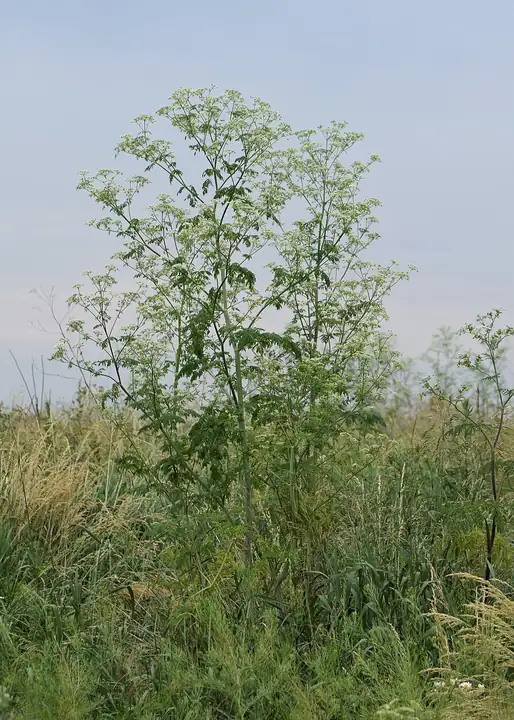
Poison hemlock
Conium maculatum
| Type | Broadleaf |
|---|---|
| Life cycle | Biennial |
| Family | Carrot family (Apiaceae) |
| Origin | Introduced from elsewhere |
| Most common in | Northeast, Midwest, Pacific Northwest, California |
About
A tall European weed in the carrot family that is deadly if eaten, by people, pets or livestock. It is spreading along roads, ditches, creeks and field edges, and it looks a lot like wild carrot and parsley.
Also called deadly hemlock, spotted hemlock, poison parsley, spotted parsley
How to identify it
Look for
Smooth, hairless, hollow stems are marked with purple or red spots and blotches. Leaves are glossy, finely cut and fern-like, and crushed leaves smell musty, like mouse urine. In its second year it grows 3 to 8 feet tall with many small, umbrella-shaped clusters of white flowers; the first year it is a low leafy rosette.
Look-alikes
Wild carrot (Queen Anne's lace) rarely tops 2 feet and has densely hairy stems without purple spots; poison hemlock is taller and smooth-stemmed. Water hemlock, which is even more deadly, and giant hogweed can also be confused with it, so never eat any wild carrot-family plant.
Where it grows
Roadsides, ditches, creek banks, field edges, pastures, fence lines and neglected garden corners, especially in moist soil.
When
Forms a leafy rosette the first year, then bolts and flowers in late spring and summer (about June to August) the second year before setting seed and dying.
How it spreads
Spreads only by seed, which can stay alive in the soil for several years.
Most common in
| Northeast | Very common here |
|---|---|
| Southeast | Common here |
| South Central | Common here |
| Midwest | Very common here |
| Great Plains | Common here |
| Mountain West | Common here |
| Southwest | Common here |
| Pacific Northwest | Very common here |
| California | Very common here |
| Alaska | Not found here |
| Hawaii | Not found here |
What to do, gentlest first
Protect yourself first. Weed killers are a last step; always read and follow the label.
Learn it and suit up Prevent
Learn the purple-spotted, hairless stem. Wear gloves, long sleeves and eye protection whenever you handle it, and keep kids and pets away.
Keep livestock out of infested spots and never feed hay that has hemlock in it.
Dig first-year rosettes By hand
Dig out small plants with their long taproot while they are still low rosettes, before they flower and seed.
Wear gloves. Bag plants for the trash, never burn them or leave them where animals can reach, and don't compost seed heads.
Pelargonic acid burndown on small rosettes Organic spray
A pelargonic acid (fatty-acid) product can burn down small, first-year rosettes. Expect to repeat it, since roots may resprout.
It kills any plant it touches. Wear gloves and read the label.
Treat rosettes with 2,4-D or glyphosate Conventional spray
Spray first-year rosettes and young plants in spring or early summer, not tall flowering plants. Repeat for several years to use up the seed bank.
Read and follow the label. Many lawn and brush herbicides also kill garden plants, so keep spray and drift off anything you want to keep.
Uses, wildlife and pets
Pets
Toxic to dogs, cats and horses (ASPCA); signs include drooling, tremors, diarrhea and paralysis, and it can kill.
Sources
- plants.ces.ncsu.edu
- extension.psu.edu
- extension.psu.edu
- extension.oregonstate.edu
- plantsservices.sc.egov.usda.gov
- aspca.org
Photo: Photo: Krzysztof Ziarnek, Kenraiz / Wikimedia Commons, CC BY-SA 4.0 (CC BY-SA 4.0). Photo resized for the web.

Planting dates and advice are general guidance; check with your local Cooperative Extension office for your area.