
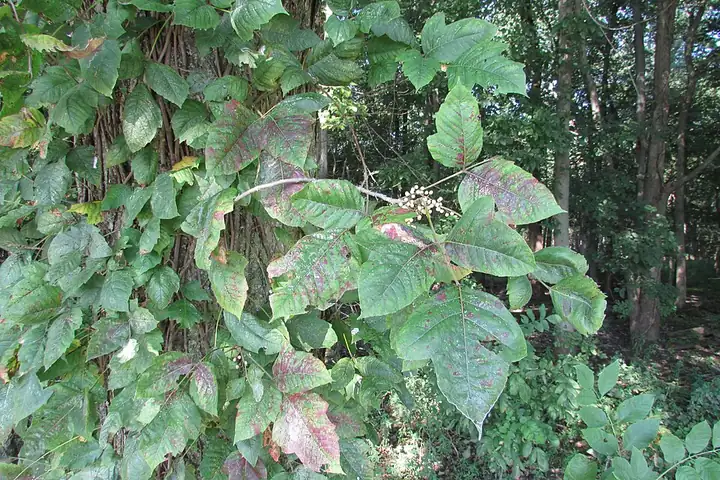
Poison ivy
Toxicodendron radicans
| Type | Vine |
|---|---|
| Life cycle | Perennial |
| Family | Sumac family (Anacardiaceae) |
| Origin | Native to the US |
| Most common in | Northeast, Southeast, South Central, Midwest |
About
A native woody vine or low shrub whose oil, urushiol, causes an itchy, blistering rash in most people. Birds plant it along fences and hedges, and it spreads by underground stems into thick patches.
Also called eastern poison ivy, western poison ivy, poison-ivy
How to identify it
Look for
Each leaf has three leaflets, and the middle one sits on a longer stalk; edges can be smooth, toothed or lobed. Climbing vines are covered with hairy-looking aerial roots, and plants bear small yellow-green flowers in spring and dull white berries in fall. New leaves are often reddish and turn red or yellow in autumn. Western poison ivy (Toxicodendron rydbergii) is a knee-high shrub that does not climb.
Look-alikes
Virginia creeper has five leaflets, not three, and box elder seedlings have their leaves in opposite pairs, while poison ivy's alternate. Fragrant sumac also has three leaflets but carries red berries instead of white ones.
Where it grows
Woodland edges, fence lines, hedges, tree trunks, stream banks, yards and city green spaces.
When
Leaves come out in spring, flowers open from spring into early summer, and white berries ripen in late summer and fall and hang on through winter.
How it spreads
Birds eat the berries and drop the seeds; shallow, far-reaching underground stems build large patches, often a single clone.
Most common in
| Northeast | Very common here |
|---|---|
| Southeast | Very common here |
| South Central | Very common here |
| Midwest | Very common here |
| Great Plains | Common here |
| Mountain West | Common here |
| Southwest | Occasional here |
| Pacific Northwest | Occasional here |
| California | Not found here |
| Alaska | Not found here |
| Hawaii | Not found here |
What to do, gentlest first
Protect yourself first. Weed killers are a last step; always read and follow the label.
Gear up and learn the leaves Prevent
Before any work near it, put on gloves, long sleeves, long pants, boots and eye protection. Check fence lines and shrub borders each spring, where birds drop seeds.
Wash tools with soap and water or rubbing alcohol afterward; the oil can stay active on surfaces for years.
Pull seedlings and cut climbing vines By hand
Pull young plants, roots and all, while they are small. On trees, cut the vine near the ground so the upper part dies, then deal with the rooted stump.
Bag the plants for the trash. Dead and dried vines still cause a rash. Never burn, mow or string-trim it. Call a professional for large patches.
Treat cut stumps or leaves with glyphosate or triclopyr Conventional spray
Paint or spray the fresh cut end of a vine, or spot-spray leaves while the plant is actively growing in early to mid summer. Regrowth usually needs a second round.
Read and follow the label. Many lawn and brush herbicides also kill garden plants, so keep spray and drift off anything you want to keep. Triclopyr harms most broadleaf plants, and glyphosate kills any green plant it touches.
Uses, wildlife and pets
For wildlife
Many birds, including woodpeckers, eat the berries, and deer and rabbits browse the leaves.
Pets
Poison ivy rarely bothers dogs, cats or horses, but pets can carry the oil on their fur to people. Wash a pet that ran through it with soap and water while you wear gloves.
Sources
- cdc.gov
- poison.org
- plants.ces.ncsu.edu
- extension.umd.edu
- extension.okstate.edu
- aces.edu
- fs.usda.gov
- aspca.org
Photo: Photo: Chris Light / Wikimedia Commons, CC BY-SA 4.0 (CC BY-SA 4.0). Photo resized for the web.

Planting dates and advice are general guidance; check with your local Cooperative Extension office for your area.