
Porcelain berry
Ampelopsis brevipedunculata
| Type | Vine |
|---|---|
| Life cycle | Perennial |
| Family | Grape family (Vitaceae) |
| Origin | Introduced from elsewhere |
| Most common in | Northeast |
About
A grape-like woody vine from Asia with colorful berries that climbs over shrubs and small trees and shades them out. It's very hard to control once established because it resprouts from roots and seeds stay in the soil for years.
Also called porcelainberry, porcelain-berry, Amur peppervine, porcelain vine
How to identify it
Look for
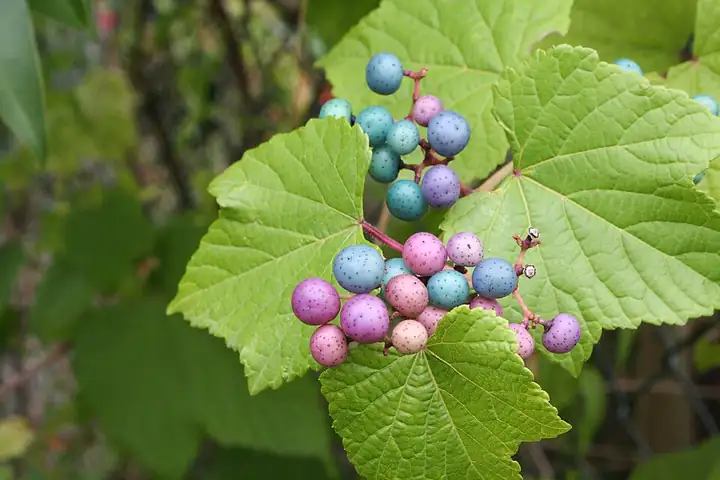
Leaves are alternate and heart-shaped with coarse teeth, often deeply cut into 3 to 5 lobes. It climbs with tendrils; the bark has small dot-like lenticels and doesn't peel, and the pith inside the stem is white. Small berries start white and turn yellow, lilac, green or turquoise in September and October, and are held upright above the stem.
Look-alikes
Native wild grapes have shredding bark, brown pith, and drooping flower and fruit clusters.
Where it grows
Stream banks, pond edges, forest edges, yards and disturbed ground; it doesn't like deep shade.
When
Flowers from June through August, and berries color up in September and October.
How it spreads
Birds, small mammals and deer eat the berries and spread the seeds, and roots resprout after the vine is cut.
Most common in
| Northeast | Very common here |
|---|---|
| Southeast | Common here |
| South Central | Not found here |
| Midwest | Occasional here |
| Great Plains | Not found here |
| Mountain West | Not found here |
| Southwest | Not found here |
| Pacific Northwest | Not found here |
| California | Not found here |
| Alaska | Not found here |
| Hawaii | Not found here |
What to do, gentlest first
Protect yourself first. Weed killers are a last step; always read and follow the label.
Plant trees to shade it out Prevent
It struggles in heavy shade, so filling gaps with native trees and shrubs helps keep it from coming back.
Pull or dig in fall or early spring By hand
Hand-pull young plants and dig out the whole root with a shovel. Collect all the fruit when you remove vines.
Bag the berries and roots; don't compost them. Expect seedlings and root sprouts for years.
Cut big vines in summer By hand
Cut large vines in summer to free trees, then treat the regrowth when it resprouts.
Glyphosate or triclopyr Conventional spray
Spray glyphosate on regrowth after cutting, or use triclopyr as a leaf spray or a basal bark treatment. Plan on repeat treatments.
Read and follow the label. Many lawn and brush killers also harm garden plants, so keep spray and drift off anything you want to keep.
Uses, wildlife and pets
For wildlife
Birds and deer eat the fruit, which spreads the seeds.
Pets
Not listed as toxic by the ASPCA
Sources
- extension.umd.edu
- extension.umn.edu
- fs.usda.gov
- plantsservices.sc.egov.usda.gov
- aspca.org
- extension.psu.edu
Photo: Photo: Olivier Vanpé / Wikimedia Commons, CC BY-SA 3.0 (CC BY-SA 3.0). Photo resized for the web.

Planting dates and advice are general guidance; check with your local Cooperative Extension office for your area.