
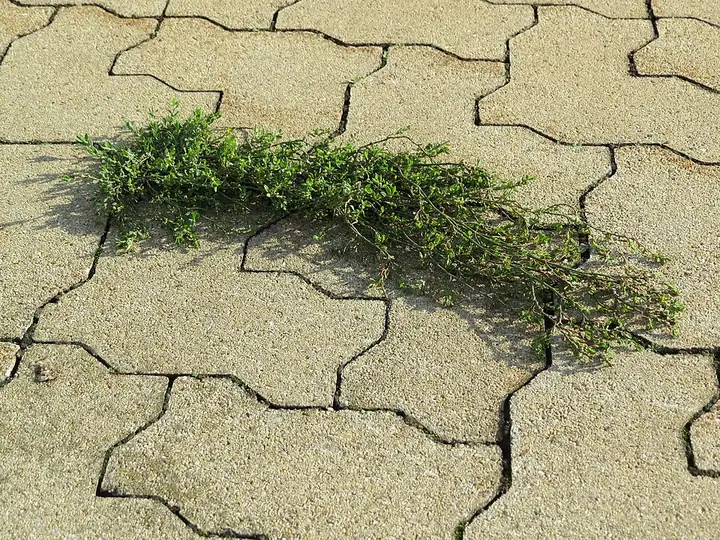
Prostrate Knotweed
Polygonum aviculare
| Type | Broadleaf |
|---|---|
| Life cycle | Summer annual |
| Family | Buckwheat family (Polygonaceae) |
| Origin | Introduced from elsewhere |
| Most common in | Northeast, Midwest, Great Plains, Mountain West, Pacific Northwest, California |
About
Prostrate knotweed is a tough, wiry, mat-forming weed of trampled ground, from sidewalk cracks to worn lawn paths. Its presence usually means the soil is badly compacted.
Also called common knotweed, knotweed, wiregrass, wireweed, matweed
How to identify it
Look for
Thin, wiry stems radiate flat from a central taproot and form a mat, with small, dull blue-green leaves set one at a time along the stem. Each leaf joint is slightly swollen and wrapped in a thin, papery sheath. Tiny white to pinkish flowers sit in the leaf joints, and young seedlings have long, narrow seed leaves that look a lot like grass.
Look-alikes
Spotted spurge also forms flat mats, but its broken stems bleed milky sap and its leaves grow in pairs; knotweed has no milky sap.
Where it grows
Compacted, heavily walked soil: paths, driveway and sidewalk edges, cracks in pavement, sports fields and worn lawns.
When
It is one of the first summer weeds to sprout, in late winter or early spring, and flowers from about midsummer into fall.
How it spreads
By seed only; the seeds are probably long-lived in soil.
Most common in
| Northeast | Very common here |
|---|---|
| Southeast | Common here |
| South Central | Common here |
| Midwest | Very common here |
| Great Plains | Very common here |
| Mountain West | Very common here |
| Southwest | Common here |
| Pacific Northwest | Very common here |
| California | Very common here |
| Alaska | Common here |
| Hawaii | Occasional here |
What to do, gentlest first
Start at the top. Weed killers are a last step; always read and follow the label.
Relieve compaction and spread out traffic Prevent
Core-aerate compacted lawn areas, keep turf dense, and add a path or stepping stones where people keep cutting across.
Hoe or pull while young By hand
Young plants come out easily with a swivel hoe or hand tool; get them in spring before they set seed, since the taproot can grow over 18 inches deep.
Mulch or fabric in beds Barrier
In beds, 3 to 4 inches of organic mulch or landscape fabric blocks seedlings; top it up every year.
Fatty-acid or vinegar burndown on seedlings Organic spray
Pelargonic acid (a fatty-acid spray) or horticultural vinegar can burn down small plants, but the crown may resprout.
Strong vinegar (over about 11% acetic acid) can burn skin and eyes, so wear gloves and eye protection. It browns any leaves it touches, grass included.
Pre-emergent in late winter or an early spot spray Conventional spray
A pre-emergent such as dithiopyr, pendimethalin or prodiamine must go down before seeds sprout in late winter. On lawns, spot-treat young plants (under about 3 inches) with 2,4-D or dicamba in late spring or early summer.
Read and follow the label. Many lawn weed killers also harm vegetables, flowers and shrubs, so don't let spray drift into beds, and keep dicamba products off the root zones of trees and shrubs.
Uses, wildlife and pets
Pets
Not listed by the ASPCA.
Sources
- turffiles.ncsu.edu
- extension.umd.edu
- ipm.ucanr.edu
- ipm.ucanr.edu
- extension.umd.edu
- plantsservices.sc.egov.usda.gov
Photo: Photo: GT1976 / Wikimedia Commons, CC BY-SA 4.0 (CC BY-SA 4.0). Photo resized for the web.

Planting dates and advice are general guidance; check with your local Cooperative Extension office for your area.