
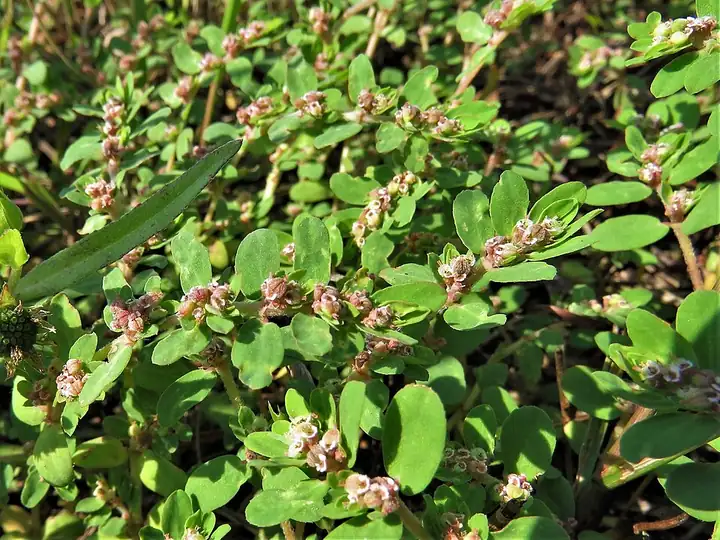
Prostrate spurge
Euphorbia humistrata
| Type | Broadleaf |
|---|---|
| Life cycle | Summer annual |
| Family | Spurge family (Euphorbiaceae) |
| Origin | Native to the US |
| Most common in | Midwest |
About
A low, mat-forming native summer annual with tiny paired leaves and milky sap that creeps across thin lawns, beds and paving cracks. The sap can irritate skin and eyes, and plants make seed within a couple of weeks.
Also called spreading sandmat
How to identify it
Look for
Pinkish, hairy stems spread flat from a single shallow taproot and often root where they touch the soil. Leaves are small (under 1/2 inch), opposite, pale green and hairy, often with a reddish-brown spot near the center. Broken stems ooze white, milky sap.
Look-alikes
Spotted spurge is nearly identical (some botanists treat them as one species) but has darker leaves and stems that don't root at the joints. Ground spurge (Euphorbia prostrata) has leaves without spots.
Where it grows
Thin or compacted lawns, garden beds, vegetable fields, landscapes and paving cracks, especially in dry, sandy or poor soil.
When
Sprouts in early summer (June and July in Indiana) and flowers nonstop from about July to September.
How it spreads
By seed, which it makes fast and all summer long; stems that root at the joints help mats spread.
Most common in
| Northeast | Common here |
|---|---|
| Southeast | Common here |
| South Central | Common here |
| Midwest | Very common here |
| Great Plains | Common here |
| Mountain West | Occasional here |
| Southwest | Occasional here |
| Pacific Northwest | Occasional here |
| California | Occasional here |
| Alaska | Not found here |
| Hawaii | Not found here |
What to do, gentlest first
Protect yourself first. Weed killers are a last step; always read and follow the label.
Thicken the lawn Prevent
Mow at the right height, water and fertilize properly, and core-aerate compacted spots so turf fills in.
Pull small mats before seed By hand
Hand-pull while plants are small and few. Pulled stems often snap and leave the root, so loosen the soil and get the taproot.
Wear gloves; the sap irritates skin.
Mulch or solarize Barrier
In beds, a mulch at least 2 inches thick (3-4 inches for coarse bark) keeps seeds in the dark. On bare ground, clear plastic for 4-6 weeks in summer solarizes the soil.
Pre-emergent before summer, spot-treat in lawns Conventional spray
Pre-emergents such as isoxaben, pendimethalin, dithiopyr or oryzalin, applied before seeds sprout, prevent it. In lawns, 2,4-D with dicamba and MCPP, or triclopyr, treats existing plants.
Read and follow the label. Many lawn weed killers also kill vegetables and flowers, and glyphosate harms any plant it touches.
Uses, wildlife and pets
Pets
Not listed by the ASPCA by name. The milky sap can harm animals that chew or eat it, and NC State Extension lists dogs and cats among those affected by spurge sap.
Sources
- purduelandscapereport.org
- crops.extension.iastate.edu
- ipm.ucanr.edu
- plants.ces.ncsu.edu
- plantsservices.sc.egov.usda.gov
- aspca.org
- poison.org
Photo: Photo: Annika Lindqvist / Wikimedia Commons, CC BY 4.0 (CC BY 4.0). Photo resized for the web.

Planting dates and advice are general guidance; check with your local Cooperative Extension office for your area.