
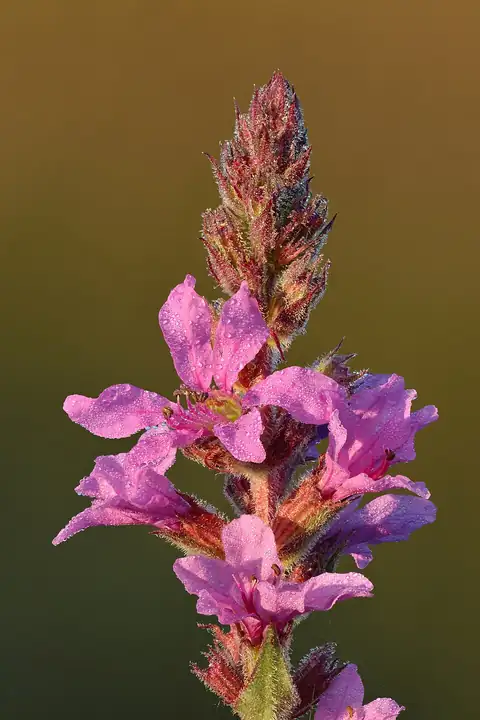
Purple loosestrife
Lythrum salicaria
| Type | Broadleaf |
|---|---|
| Life cycle | Perennial |
| Family | Loosestrife family (Lythraceae) |
| Origin | Introduced from elsewhere |
| Most common in | Northeast, Midwest |
About
Purple loosestrife is a showy Eurasian wetland perennial, once sold as a garden plant, that chokes marshes, ditches and shorelines. One plant can make millions of seeds, and even 'sterile' garden cultivars cross with wild plants to make seed.
Also called loosestrife
How to identify it
Look for
Stiff, square (four- to six-sided) stems grow up to 10 feet tall from a woody taproot, with 30 to 50 stems on older plants. Smooth, lance-shaped leaves up to 4 inches long sit opposite or in whorls. From July to September it carries tall spikes of pink-purple flowers with five or six petals.
Look-alikes
Native fireweed has round stems and alternate leaves, and Douglas' spirea also has alternate leaves. Native blue vervain can also be mistaken for it.
Where it grows
Wet soil and shallow water: marshes, pond and lake edges, ditches and wet gardens.
When
It flowers from early July into September, and seed ripens from late July on.
How it spreads
By seed (up to 2.7 million per plant a year) carried by water, wind, animals and equipment; seeds can lie dormant for years.
Most common in
| Northeast | Very common here |
|---|---|
| Southeast | Occasional here |
| South Central | Occasional here |
| Midwest | Very common here |
| Great Plains | Common here |
| Mountain West | Common here |
| Southwest | Occasional here |
| Pacific Northwest | Common here |
| California | Occasional here |
| Alaska | Not found here |
| Hawaii | Not found here |
Where it is regulated
Listed as a prohibited noxious weed in Minnesota and a B-rated noxious weed in Oregon.
What to do, gentlest first
Start at the top. Weed killers are a last step; always read and follow the label.
Don't plant it; grow natives instead Prevent
Don't buy or plant loosestrife or its cultivars, and check wildflower seed mixes. Minnesota DNR suggests swamp milkweed, cardinal flower, Joe-Pye weed, blue vervain or blazing star instead. Report new wild patches.
Planting it is illegal in some states, including Minnesota.
Cut flower spikes and dig out plants By hand
Cut off flower spikes before seed forms and dig out young plants with the whole root. Bag everything for the trash.
Never compost it. Clean boots and tools so seeds don't travel. Work near public water may need a permit.
Galerucella leaf beetles Natural enemies
Leaf-eating Galerucella beetles are used for large stands (about an acre or more). Ask your state DNR or Extension.
Spot-spray triclopyr or glyphosate Conventional spray
Oregon State lists triclopyr (spares most grasses), glyphosate and imazapyr for spot treatment.
Read and follow the label. Many lawn weed killers also kill garden plants, so keep spray and drift off beds and vegetables. Near water, only aquatic-labeled products are allowed, and they often require a licensed applicator.
Uses, wildlife and pets
For wildlife
Poor habitat for wildlife compared with the native wetland plants it replaces (Minnesota DNR).
Pets
Not listed by the ASPCA.
Sources
- dnr.state.mn.us
- dnr.state.mn.us
- solvepestproblems.oregonstate.edu
- plantsservices.sc.egov.usda.gov
- aspca.org
Photo: Photo: Ivar Leidus / Wikimedia Commons, CC BY-SA 4.0 (CC BY-SA 4.0). Photo resized for the web.

Planting dates and advice are general guidance; check with your local Cooperative Extension office for your area.