
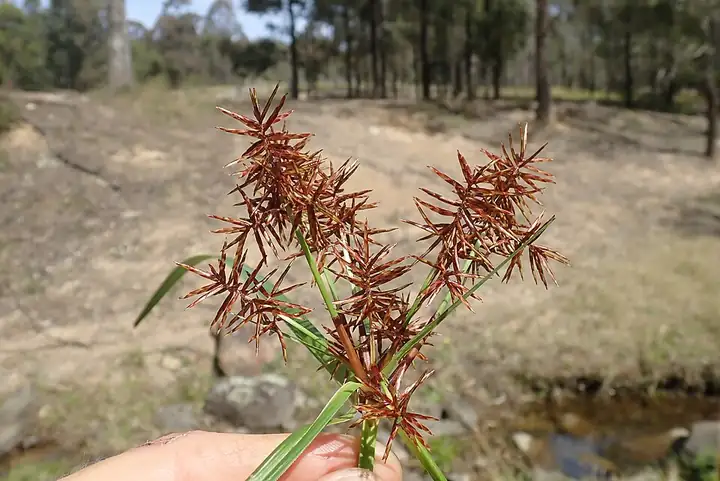
Purple nutsedge
Cyperus rotundus
| Type | Sedge |
|---|---|
| Life cycle | Perennial |
| Family | Sedge family (Cyperaceae) |
| Origin | Introduced from elsewhere |
| Most common in | Southeast, South Central |
About
A perennial sedge from the Old World tropics that ranks among the world's worst weeds. It is a big problem in warm southern lawns and gardens because its chains of tubers regrow after almost every attack.
Also called nutgrass, nut grass, coco grass, java grass
How to identify it
Look for
Stems are triangular. Glossy, dark green leaves grow in threes with rounded to blunt tips and have no ligule. Seedheads are reddish to purplish brown, and underground runners carry chains of bitter tubers covered in red-brown scales.
Look-alikes
Yellow nutsedge has lighter leaves with sharp tips, golden seedheads and single tubers. Green kyllinga is shorter with round green flower heads and no tubers.
Where it grows
Warm, sunny lawns, vegetable gardens and beds, mostly from Virginia to Texas and in parts of Arizona and California.
When
Tubers sprout once soil passes about 59 degrees F in late spring, and the tops die at the first frost while tubers overwinter.
How it spreads
Spreads almost entirely by tubers, since it rarely makes seed in the US; one tuber can form 99 new tubers in 90 days.
Most common in
| Northeast | Occasional here |
|---|---|
| Southeast | Very common here |
| South Central | Very common here |
| Midwest | Occasional here |
| Great Plains | Not found here |
| Mountain West | Not found here |
| Southwest | Common here |
| Pacific Northwest | Not found here |
| California | Common here |
| Alaska | Not found here |
| Hawaii | Common here |
Where it is regulated
Oregon lists it as an A-rated noxious weed to be eradicated if found.
What to do, gentlest first
Start at the top. Weed killers are a last step; always read and follow the label.
Shade it out and fix wet spots Prevent
Nutsedge grows poorly in shade, and too much soil moisture helps it, so fix drainage and keep plantings dense.
Pull young plants often and dig deep By hand
Remove plants with fewer than 5 leaves every 2 to 3 weeks in summer. For bigger plants, dig out the tubers and base, going 8 to 14 inches deep.
Pulling can wake up dormant tubers, so keep at it, and don't till infested soil.
Dry out tubers, or use woven fabric Barrier
In midsummer, work the soil to bring tubers up and hold back water so the sun dries them; repeat each summer. In beds, heavy woven landscape fabric under mulch suppresses it.
Plastic mulch won't stop it; the shoots pierce it.
Halosulfuron, sulfentrazone or imazaquin Conventional spray
Spray young, actively growing plants in lawns with halosulfuron or sulfentrazone, or imazaquin in warm-season grass, and expect to repeat. Mature plants and tubers are hard to kill.
Read and follow the label. Many lawn herbicides kill garden plants, so keep spray and drift off beds and vegetables.
Uses, wildlife and pets
Pets
Not listed as toxic to dogs, cats or horses by the ASPCA.
Sources
- ipm.ucanr.edu
- ipm.ucanr.edu
- aggieturf.tamu.edu
- plants.ces.ncsu.edu
- oregon.gov
- plantsservices.sc.egov.usda.gov
- aspca.org
- aspca.org
- aspca.org
Photo: Photo: Macleay Grass Man / Wikimedia Commons, CC BY 2.0 (CC BY 2.0). Photo resized for the web.

Planting dates and advice are general guidance; check with your local Cooperative Extension office for your area.