
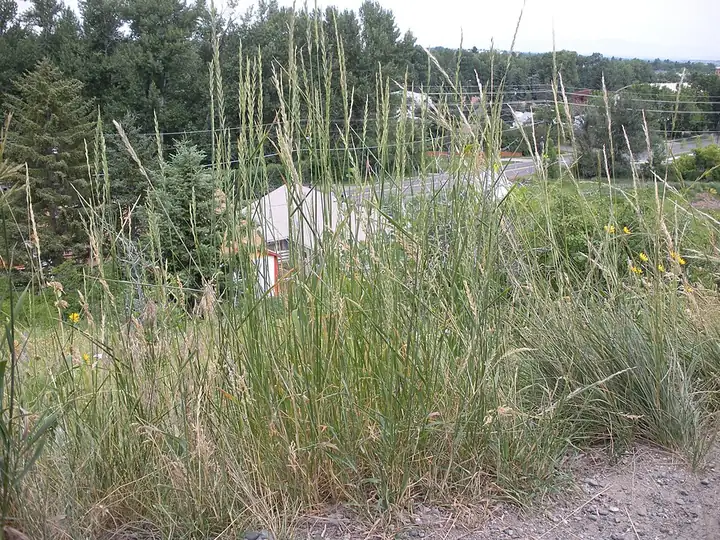
Quackgrass
Elymus repens
| Type | Grass |
|---|---|
| Life cycle | Perennial |
| Family | Grass family (Poaceae) |
| Origin | Introduced from elsewhere |
| Most common in | Northeast, Midwest, Great Plains, Mountain West, Pacific Northwest |
About
A cool-season perennial grass from Europe and Asia that creeps by long, pale, sharp-tipped rhizomes. It invades lawns, vegetable gardens and flower beds, and any root piece left behind can grow a new plant.
Also called couchgrass, common couch, quitch grass, dog grass, scutch grass
How to identify it
Look for
Upright blades with a rough upper surface, often pinched in near the tip. At the base of each blade, small claw-like auricles wrap around the stem, which is the best clue. The seedhead is a narrow spike 2 to 8 inches long, and the rhizomes are pale yellow with sharp points.
Look-alikes
It can pass for a lawn grass, but it grows taller and faster between mowings. Check for the clasping auricles and creeping rhizomes.
Where it grows
Lawns, vegetable and flower beds, fence lines, fields and waste areas, especially on fertile soil.
When
Greens up in early spring, grows through fall, and puts up seed spikes in summer.
How it spreads
Spreads mainly by rhizomes that run 3 to 5 feet out in the top 6 to 8 inches of soil; each seed spike holds 25 to 40 seeds, but many are sterile.
Most common in
| Northeast | Very common here |
|---|---|
| Southeast | Occasional here |
| South Central | Occasional here |
| Midwest | Very common here |
| Great Plains | Very common here |
| Mountain West | Very common here |
| Southwest | Occasional here |
| Pacific Northwest | Very common here |
| California | Common here |
| Alaska | Common here |
| Hawaii | Not found here |
Where it is regulated
California and Colorado list it as a noxious weed, and Oregon includes it in its noxious weed quarantine.
What to do, gentlest first
Start at the top. Weed killers are a last step; always read and follow the label.
Keep turf thick and bring in clean material Prevent
A dense, healthy lawn is the best defense. Check grass seed mixes and sod before you buy, and compost properly so rhizomes don't hitchhike in.
Fork out every rhizome By hand
Loosen soil with a garden fork and pull out plants with all their rhizomes, then keep removing new shoots. It's slow work, but steady digging wins in small beds.
Tilling chops rhizomes into pieces that each regrow. Shallow bed edging won't stop runners, which can travel a foot underground.
Spot-spray glyphosate, or fluazifop in beds Conventional spray
Spot-treat actively growing plants with glyphosate, which kills lawn grass too, then reseed. In landscape beds, the grass-selective herbicide fluazifop can control it among many broadleaf plants.
Read and follow the label. Many lawn herbicides kill garden plants, so keep spray and drift off beds and vegetables. Pre-emergents do nothing against this perennial.
Uses, wildlife and pets
Pets
Not listed as toxic to dogs, cats or horses by the ASPCA.
Sources
- ipm.ucanr.edu
- extension.umn.edu
- hortsense.cahnrs.wsu.edu
- invasivespeciesinfo.gov
- extension.umn.edu
- plantsservices.sc.egov.usda.gov
- aspca.org
- aspca.org
- aspca.org
Photo: Photo: Matt Lavin / Wikimedia Commons, CC BY-SA 2.0 (CC BY-SA 2.0). Photo resized for the web.

Planting dates and advice are general guidance; check with your local Cooperative Extension office for your area.